Dear Secretary of State for Education – as of 5th July 2024

05-07-24

Dear (new) Secretary of State for Education

You are the 24th SoS since I started working in schools in 1981 and either the 18th Tory or the 6th Labour leader of the sector I loved. There are a number of issues in Education needing urgent attention post-election here are my thoughts for what they are worth. ANY politician or party needing more info, you know where to find me! In order 10/10

1 SEND – too many councils taking too long to sort them for families but more important not enough resource in the system to support those EHCP – so you might suspect the tardiness is about funding. Families struggle to access special school places – many perhaps don’t need (or want a special school) but if we are honest too many schools are not inclusive and therefore make excuses not to take some children with SEND needs. Sometimes this is very subtle – an open evening where for some reason the SEND team aren’t available! Sort funding, review SEND and implement the Timpson review on inclusive practice. I’m not against exclusions including permanent exclusion. Behaviour is really really important but – once you exclude the naughtiest pupil in the school, you then have to deal with……..the naughtiest pupil in the school. No doubt ( see below) we need better local services here to help. Look at helping make schools more inclusive or rewarding those that are. It is a great joy for a school community to have all sorts of children along with their interests, ambitions, needs. There is a place for Special Schools but these ought really be for those with much more complex need. Do simple arithmetic – 15% of pupils have SEND – what % should be in Special and therefore how do we help that majority in the maintained sector? Remember these families often have the hardest of times and feel they are constantly battling.

2 Teachers – it’s no good having great buildings if there are not great teachers or even enough teachers. There is an urgent need to review pay and conditions and talk with TU and with staff. Why are they leaving ? Why are so many retiring early? Why isn’t my secondary age child taught by a graduate or expert in that subject? Some of this is pay and conditions – graduates command better pay elsewhere – elsewhere in other sectors or elsewhere in the world. Some is due to autonomy and the school structure and regulation. Teachers might hate Ofsted not because of fear of accountability but because so often their leaders say ( rightly or wrongly) Ofsted (and the MAT) demand X or Y. Personally I loved teaching, I loved planning every day, every year, working out new content or even old content,  new ideas, new ways to get over hard Chemistry and new ways to assess, or to help my students. I did not like being told how to teach – once a deputy told me I needed to return to the old ways of science ie heading/method/diagram/results/conclusion. I asked why when exams did not examine like that and science didn’t really work like that and how did he know when I was a mini expert in teaching and in my subjects (RSC award winner!) …. But if you keep getting “the MAT says so” or the LA says so” or “Ofsted demands ” it is soul destroying. BUT there is also something about the curriculum fit for children and young people. Please don’t negelect CPD, keep it local too learn from those around the corner doing better, use Univeristy ITT and research, forget the blob nonsense. There is great expertise to tap into but if you keep hubs move on from nepotism.

Many in a class are disillusioned, disengaged – it may be them of course BUT imagine what subject you hated most at school – for me that’s Art. Now imagine you have to do that all day every day except for a few hours of your favourite subject. Imagine all the creative stuff being downgraded, imagine all the extracurricular gone- few teams, no regular concerts or shows… and that school is dry. My old head allocated 1200 of 1265 hours and then said …” You have 65 hours unallocated, do something with children – a lunch time activity, an after school class , run a team, take a trip away…” difficult to argue and so we had one of the most rich extra curricular offers and we knew our children and families all the better I’ve blogged elsewhere on that.

I had the privilege as a local Director to visit many local schools and often, very often I met ex pupils, inspired by our school to teach, to be a SENCO, to be a TA to be a business manager. It made me very very proud, yep morally onto the high ground. Young people should want this wonderful job it shouldn’t be difficult to attract them again. [There’s a whole section here on why be a teacher!]

So this needs 

3 A review of curriculum to fit a 21st Century world, a world where knowledge helps but a decent crap detector is better – where you learn how to find knowledge and discern its value, where you learn from an expert who absolutely loves and inspires you in their subject – how lucky was I to work in a school full of staff like that? And consider how assessment helps learning NOT constantly measuring it (P8 EBacc etc) these measures crudely comparing children or schools – move on- you know Gove, he might have been wrong! and by the way you need to do this for FE colleges too – FE could make the biggest of differences to your ambitions but fund them, listen to them – to quote Sir Keir Stamer ” If you spent more time listening you might not be so out of touch” Oh and by the way listen to professionals across the spectrum no decisions for the media, none – that gets us nowhere ( See Brexit).

Rethink P8 it’s distorting classrooms – sure Maths and English are important but we don’t need a formula to tell us and an emphasis that promotes subjects or demeans others – it may be too late for music, Design, Performance subjects but bring back a fair choice and subjects by their own value and merit- not the values of one politician (Gove) or favouritism.

4 Ofsted Much is written on this, here is my view. Get rid of judgments – I have always hated them, even when we sat on “Outstanding” for over 10 years. What did it mean? If you asked the staff, children or parents about our school they would mostly be positive, they would say some things, the music, concerts, sporting occasions, wider opportunities and outcomes were good and often amazingly brilliant. They would say mostly their children liked coming to school though not every day! You see they might also add some days were pretty ropey, some days behaviours deteriorated and some stuff really needed to change. Other parents in Nottingham might say – we knew that this school was Outstanding, thanks for the info but we will never get in ( which is true we usually had 500+ applications). How dare anyone sum up the work of 1200 children 130 teachers and support staff over 195 days in one word. There is an argument to get rid of Ofsted but I suspect that’s a step too far even for a radical majority led government, sadly. So Ofsted reports should be like the local area SEND reviews done by Ofsted and CQC. Spend time, not just a day – praise what is going well ( so we know and carry that on) tell us stuff you think we need to work on and tell us anything urgent needing attention. If if if the list of improvements needed is too long make us do an action plan and revisit in the year, give the LA or MAT some resource to help. One big issue here is the almost unspoken politics. The regulation is a way to create more academies -a one way move if your inspection is poor. 

There is always a political argument that “Parents need to know and surveys show they like Ofsted”. This is somewhat disingenuous and naïve. As above a school rated good ( which now covers a huge spectrum, maybe brilliant some days and struggling on others. It may change in a short period of time ( we once had 6 English staff off on maternity leave, that was a challenge!). There is an argument about it helping when choosing a school but parents do not choose a school – they express a preference and in most areas they have no choice – in fact the schools effectively choose them  especially if oversubscribed. There is a really tough issue her for a school labelled RI ( requires improvement) as parents see this as a ‘bad’ school and try to avoid it for their children and as some teachers may shun the ‘opportunity’ to work there. If anyone has been at school appeal panel they hear all these arguments – and the panel have to try and explain that an RI school isn’t that bad, it will get better, lots of children do well there etc. In the light of the tragedy of Ruth Parry and the mishandling of that by Ofsted, the least we can do is stop the one word judgment and at least get rid of those media stories ( our local Nottm Post “Here are all the outstanding schools in Nottingham” – which our local news outlet ran with 5 errors and no context that the framework has changed that 15% O became 12% O)). Make the media, make the parents read the reports and remind them some are 5 years out of date and were done by two adults in one day. It’s a pressure on inspectors too. Would we do this to industries? Imagine I visited Boots ( I am a scientist) and with a couple of colleagues found want and all over the papers Boots judged RI – and by the way we will be back in a few years, and the press ask about the consequences for profits and jobs and maybe even the companies existence. I realise in education we are talking public money but believe me we are accountable

5 The System. We now have MATs, we have some LAs still running schools – often Primaries and Special. There has always been a feeling the latter are second class, in terms of funding and favouritism. Just as an example when a poorly achieving school is moved to a MAT the Trust may get extra funding – perhaps if the LA had received that, the school wouldn’t have fallen over.  There are really good MATs, I’ve worked with some in Nottingham, there are also poor ones, there were poor LAs and I’ve worked in some good ones ( Oxfordshire under Sir Tim Brighouse). This shouldn’t be about ministerial or political whims – such as ‘all schools should be academies’ or ‘stand alone academies can’t stand alone any more’ or bring back more grammars. Do some proper research on what works and what doesn’t; take time listen to a wide view run away from nepotism. make a long term strategic plan and win over cross party support to rebuild over 10 years

6 Governance – here is a question, when a parent has a complaint how easily is it resolved? Not the persistent offender parent the serial complainer, just the parent who feels their child isn’t say getting adequate support? They might try and talk to teachers, TAs, maybe the head but if not resolvable where then? My experience in an LA was that many exasperated parents turn to the LA, who has no powers over MATs. They might threaten Ofsted but they will rarely intervene unless it feels like a big safeguarding matter and then will seek info from others. Some schools now have little local governance. MAT governors at Trust level are very removed from the needs and the joys of the local school. Then there is the unspoken sponsorship – businesses or even political interests, donors to the parties, nepotism over schools -it’s not good enough. Run the school, hold people to account, support and challenge. Our CoG always rang me to see how things were going, she turned up at every concert, every Governor meeting, and every sub committee meeting, her children came to the school, she supported PTA events – she loved the school and when she was critical we all listened, we listened all the more carefully for this lady loved the school.

7 Universal Services Since council budgets have been cut schools are the places for many vulnerable and disadvantaged families to turn – for food, for clothing, for holiday hunger for help and for love etc. Schools helping them with paperwork etc. Teachers wanted to teach they might be Ok with pastoral work they understand wider responsibility but they’ve got tied up with too much universal support. Please urgently help sort the finances of councils for Children’s services esp for Children in Care where placements and costs, thanks to a market economy are ridiculously high and yet the children still get a poor service. Talk to Councillors and Officers who know their communities well and start working on solutions, and please talk to children in care. Think about libraries, children’s centres, youth services. You know why? They often reinforce good behaviours and help keep people on track – look at the Pythian community in Nottingham; look at the work of early years…..

Oh and whilst I mention it – councils are in a good position to create great partnerships – schools colleges Universities, other provision like AP and Early years but alongside cultural and sporting partners – they did really good stuff in the pandemic – give them resource for this and please please help with place planning – opening or closing schools is so painfully slow because of the academy obsessions.

8 Mental Health – why is that so bad here in the Uk compared to most other European Countries? Why haven’t we bounced back after the pandemic? Why is attendance such an issue? Talk to schools and work a strategy. Talk to young people. Locally our NottAlone website has been a great success – this may need money but it may need creativity, coproduction and better solutions.

9 Buildings.Schools had RAAC feel it’s probably been forgotten, BSF was Gove’s first cut and stole the investment which was needed to help transform learning. So too have the regular maintenance issues of boilers, leaky roofing, better ventilation etc. This needs a simple plan but a costed one. Do simple arithmetic- there are about 21,000 schools, if the buildings last 50 years we need to rebuild ( and set aside funds) for approx. 400 per year . If they last a bit longer because they are well built then that decreases. Why can’t our children learn in reasonable or even nice buildings. Most of my time I taught with leaky ceilings, cold labs in winter, stuffy ones in summer, unfriendly places – but give me a good school in cr*p buildings any day.

10 Locally good, locally accountable and local to me

This in realty is the most simple yet the most complex. What all parents want and all teachers want and all children deserve is a good local school. Yep, just a plain simple good local school – a good curriculum, staff who know their children and can inspire them and teach them and stay the course and frankly love them. In my very personal view too much resource is centred on the MAT team, the business and the CEO and senior staff, not only too much money but too much power. ( see the amazing work of Warwick Mansell on this. Restore that power to the governors and the headteacher, support the headteacher, challenge them but work out how to do that without a super head, without X who turned around school Y. Listen to the heads who love their schools, love most of their staff and love most of their children. You  might be surprised just how many of them there are, awaiting the changes we need and already serving their local community.

Friday period 3 – Secondary schools – trust, thank and love your Primaries

As a new head I have been reminded of that infamous Donald Rumsfeld quote. Slightly misquoting him: “There are aspects about being a headteacher which I think I know about: teaching, learning, assessment, results, data, behaviour, systems, child protection etc Then there are some aspects I know I do not know so much about, for me these include primary transition, special needs, curriculum planning, budgets and HR. Then of course I have found things I never knew I was supposed to know about like counterterrorism, energy status, injections. Fortunately I have really good people around me helping me, as well as my own mentor. I decided to include in my first term a visit to the primaries associated with our school and meet the children and staff without being a nuisance. I already knew my primary head colleagues in our Trust were good people from previous meetings with them but what a privilege to see them in action in their own schools. It was also special for me to find many ex-students now teaching or being TA’s in those schools. Wonderful to see young people who we had helped through the sixth form with progress into HE and UCAS decisions and A Level stress who got into their chosen courses and now were proving to be great primary staff.

When I was a head of sixth form it was obvious to me that we benefited post 16 from all the work staff (including me!) had put into the pupils in KS3 and KS4 – not just their learning but also their attitude and behaviours. Why had I never thought about that in the same manner when considering our primaries. So here are some reasons why I love our primaries:

1.Managing Change. imageThere may be different sorts of change in Primary schools but they are still having to work hard on stuff like ‘life without levels’, like SEND. Whilst I know they don’t get so much PP time I had overlooked staff are not necessarily part of big teams for support, help and sharing. They may do so with other schools but it is still time consuming and like us they are all committed to delivery in the classroom. This means it can feel lonely managing change – but they get on with it!

2.The bread and butter work imageThe basic are no different, teaching, learning, behaviour, attendance, etc The pressures might be a little different (Ok so no difficult teenagers) but I had forgotten the issues as my own children are now grown up and they have to cope with the usual ups and downs of life but meeting issues of ill parents, or bereavement perhaps for the first time. I’ve not written much about our buildings, just to say we lost our bsf and have had very little capital investment but done our best to look after the site even with a road in between. However these might fade to be less significant compared to some of the issues with little people and their facilities. So often I was reminded of my favourite quote from a colleague. Better to be a good school in poor buildings than be a ……

3. Know your children. In our primaries the heads seem to know all the children, the children so look up to them and are so pleased when the head notices their progress which they do often.Well hang on I have the same aim, I try to ask pupils how they are getting on but looking again at my intro I have people to help me with budgets, HR, cover. They have help and they might be smaller but I was still impressed they keep such a high priority on the learning going on. They are also fairly expert in everything – I’m quite good at science and reasonable at maths and ICT and a few other areas but a bit clueless on others like Art ( despite my efforts) – back in the KS2 arena they seem to know everything. I was reminded just how great are great primary teachers.

image

4.The work. I saw so many enthusiastic children and teachers and all working really hard, I was literally blown away by what I saw going on and by what was in the books and indeed the marking and feedback. My previous admiration of the primary teacher moved up a few notches. I met some Year 0 children searching for photos on the computer, copying and pasting, I started by being impressed and then was a bit scared about what they will be like by age 11 when we get to see them in a secondary.

image5. The ethos. If reader you have seen my blog about Chinese heads visit they kept asking me how we got the school ethos over to the children, a question I continue to think about and wrestle with answering. Well here was something to help my thinking – it starts in Primary. This might be because we are faith schools in a RC MAT and so the ethos of an RC school is fairly clearly defined, we have priests who work with us all, we even share our chaplains. Whether it’s that or something else I can see just how much we benefit from the way our primaries are bringing up their children.

So here I am bowing down to the empire of the Primary sector, the Kings and Queens and the foot soldiers and saying thank you for all you do. It confirmed for me the best reasons about academisation was working even more closely together with the primaries to serve our community. A community where the little people I met asked me if I knew their older brother or sister at “your school” – some I did but some I didn’t; a confession none of those heroic heads would be ignorant about. A community where many of the primary staff went to our secondary or have children at our secondary or worship in our parish communities. I so thank you for allowing me a glimpse into your world, thanks for all you do, keep it up. You have helped me with my vision, I hope we can continue to work together over transition and in the future I suspect we might find ourselves working even more closely together. In every sense we really are in this together!

image

Here is a challenge- work with a feeder primary organise teacher visits maybe half a day – see their job; planning, teaching, marking, assessing, feedback see how little people tick. Then swop, and let them see you. Have some time discussing with each other what you find out about the job. I bet it leads to school improvement – bet!

Questions

Q1 What ways can we help each other without any patronising or unnecessary attitudes?

Q2 What ways might we improve transition, especially with the issues around admissions?

Q3 Closer ways to work together for primaries and secondaries in the future?

For those in Church schools

Ephesians 6:2-4 Children, obey your parents in the Lord, for this is right. “Honour your father and mother”—which is the first commandment with a promise—so that it may go well with you and that you may enjoy long life on the earth”. Fathers, do not exasperate your children; instead, bring them up in the training and instruction of the Lord.

1 Peter 2:17 Show proper respect to everyone, love the family of believers, fear God and honour the emperor.

Acts 24:3 Everywhere and in every way, most excellent Felix, we acknowledge this with profound gratitude.

Ephesians 4:16 From him the whole body, joined and held together by every supporting ligament, grows and builds itself up in love, as each part does its work.


You might like to read other posts from my timetable of teaching – each is set out from lesson in the school week, before or after school or at the weekends, appropriate to the time of day. I have also started a  class lists or “set lists” which was to answer the questions: “why be a teacher?”or “why have other responsibilities in a school?” Shortly I am starting a new area about progress from one role or experience in teaching to another with hints and tips about successfully moving on in the job and your teaching career.

Wednesday Period 6 – Teachmeet Virgin

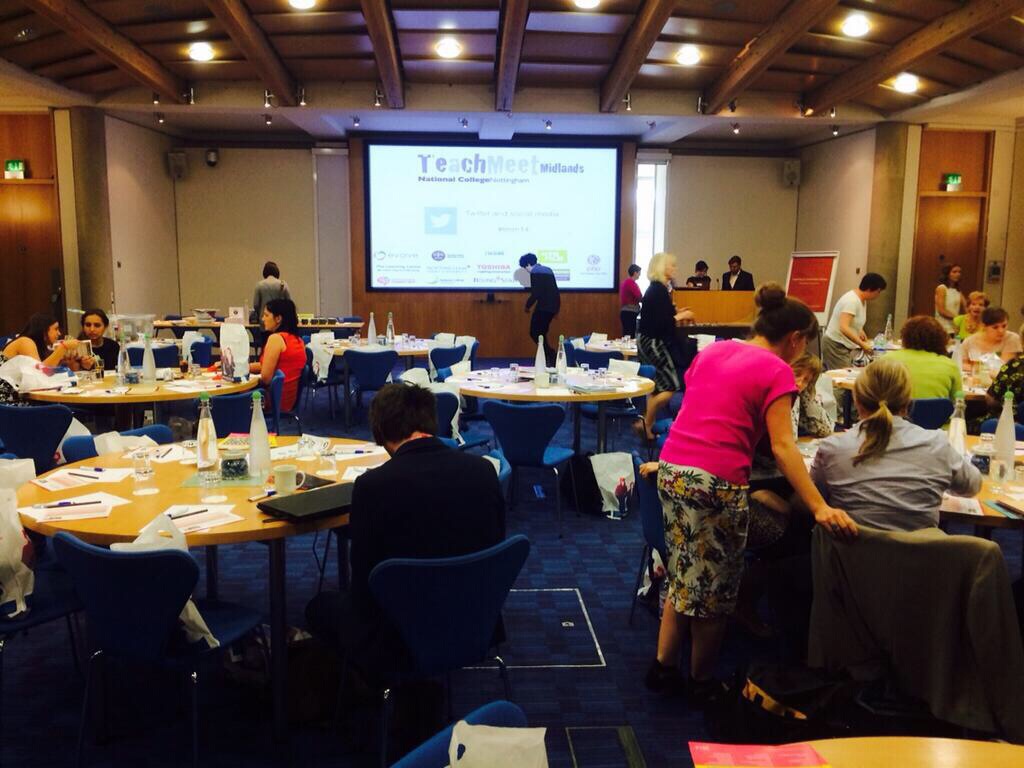
So my first ever teachmeet, 25th June 2014 – sorry to those old hand teachmeet -ers. Tempted as I am to compare it with my blog about meetings, and give a score, this is a very different sort of meeting. No one is compelled to go and it seems only enthusiasts do the presentations, and teaching is blessed with many enthusiasts, truly! Note that carefully any readers who are not teachers!

So what happens is you sign up then turn up – I did so with about 100 others in Nottingham attending the National College. What a great place to meet on a sunny summer evening! I am so jealous, there are many new buildings around the Nottingham City area for education thanks to the investment of two great Universities, and our local FE colleges and lots of bsf investment in many schools. I am deeply jealous as my school lost its £16m BSF as we were deciding the colour of paint at the end of 18 months planning, despite a judicial review Mr Gove took the money back. (So still crossing a road between sites in the rain and loving those 60’s corridors!) Hey but that’s not what my blogpost was about and neither is it what a teachmeet is for, except the building, the room, the hospitality, food and drinks are pretty important when the show runs 5.30 to 9.00. So well done organisers, that was all as it should be. The technology needs to be up to it too, there is swift movement between presentations for laptops/screens etc and twitter seemed compulsory, so accessing wifi and clear screens to read and watch video etc is vital to success.

There were some ‘goody bags’ give aways; some fliers from sponsors, some advertising materials. We sat on tables of up to about 10 people and the most enthusiastic discussions came undoubtedly from tables where there were a number of staff from a school or maybe two schools. Murmurs of excitement during a presentation and enthusiastic chatter afterwards.

Once the show kicks off, if you haven’t been to one, there are presentations lasting 2 minutes, 5 minutes or 7 minutes and some people did keep spot on with time, and there were others! We started with @Hywel_Roberts who was fantastic, definitely stimulating and every point was well made with great (northern) humour, great imagination and creativity. Secondary classrooms might benefit from a good dose of that. I couldn’t help be carried along, drawn in and excited by his challenges. fast moving but uplifting – hey there is the word in my blog about meetings. I was a bit frustrated because there was no overall theme or topic and the evening covered items across all sorts of sectors, however I reminded myself that I am an educator, albeit in secondary and we build on stuff from primary or early years etc [Thank you Primary ppl; Thank you EY ppl]. There were some great ideas shown off, really great – could I use them all, not really in a secondary classroom but seeing beyond that was interesting.

There is also the spin off of the network, I was very pleased to see a number of colleagues and some ex pupils now teachers. Networking isn’t easy though if everyone stays on their own table. Not quite true of course because there is the old twitter hashtag #tmm14 and thanks to @paulyb37 a running commentary and some good work from @MarcWithersey and @PeteBevington. There were supportive tweets when their school colleagues presented (difficult to cheer or whoop but anything goes on twitter!) and commendable comments for good presentations and the usual humorous banter, and I saw nothing critical or nasty- that’s teachers for you. If you wish check out the twitter feeds.

So I am now wondering and pondering where teachmeets fit into the CPD spectre:

Q1 Are themed teachmeets effective CPD ?
Q2 Are they more effective in say a primary sector where a meeting brings together lots of schools and their staff?
Q3 Is the model that is “teachmeet” something we should try within say a big secondary school? A model for a twilight, for an INSET; a way to bring different groups of staff or even different school staff who teach e.g. Science together? [I shall investigate this with my next teachmeet]
Q4 Is there any research about the success of a teachmeet, save the attendance numbers?
Q5 Why do you go?

20140626-224026-81626015.jpg

Saturday Period 1 – Research Ed. Me, really?

This is my first attempt at a blog – it probably ‘requires improvement’ (RI) most things do. I hope it might help encourage teachers to become Tweachers(use twitter), read blogs (not necessarily mine) and learn about CPD opportunities. #NTENRED

So Saturday period 1 I usually like to make a long lesson mainly because it comes between Friday period 5 and Sunday period 1 which obviously brings Monday period 1 ever nearer. I try and do very little work Saturday period 1 because everyone tells me we need a work life balance, so no planning or marking or admin, but there is always thinking about school, almost always – there was when I had a full timetable and there is now (as Tom Bennett put it) that I have a fuller wallet and easier timetable being SLT.

This Saturday 3rd May I was in school, not mine but Huntington, there were lots of teachers SLT, heads, researchers and maybe 400 in total (someone can correct me) on a bank holiday Saturday. I got there really thanks to twitter and have tweeted with many people who were there. I think I have met two of them before, I felt I knew them from their writing, their tweets, though not from their twitter images and well it turned out the reality was even better than the virtuality. So my purpose is to encourage you to get on twitter, to get along to a Research Ed conference or maybe a teachmeet. Why?

I wish that I had been able to do a wordle of the day – most common words I heard were: teachers, learners, thriving, progressing, inspiring, sharing, reflecting, evaluating (well and a few more). What I didn’t hear much about was inspecting , Gove (one mention) politicians, targets. So frankly I found myself enjoying Saturday assembly with the inspirational John Tomsett, who in talking to us was as good as his blogs;

Period 1 with Mary Myatt I was seriously reminded about the aspects of teaching and learning I so love. She showed us that research is already happening and easy to encourage and profound in it’s ability to raise energy and passion in the day to day job and its ability to bring life cannot be unedrestimated. I agree

Period 2 with David Weston proved my decision to ‘work’ on Saturday was right as he said so much CPD gets lost once we return to that hurley burley which unlike in ‘that play’ is never “done”. David’s point ‘ the best CPD is aspirational, collaborative relevant, differentiated, sustained, underpinned by research, evaluated and led by leaders who model great learning and demonstrate trust and distributed leadership’ wow just that pearl makes me think about what we can do.

Period 3 we looked at some possible NFER evaluative tools. I find evaluation so hard to do, time being a major issue and was encouraged to see there is no easy, obvious way to do the task. However the tools here looked useful -we’ll see.
Lunch without supervision meant I could talk with a colleague who was also in York. An enjoyable conversation, a chance to catch up with a valued teacher colleague a reminder of the importance of finding a bit of time to do so.

Period 4 is a tricky slot and Jill Berry spoke about the transitioning from deputy to head and her research in that area. I tweeted this was more helpful than much of my NPQH but it was refreshing to hear from a wise practioner who is looking to help the profession on this task and who hasn’t joined the inspection brigade (sorry if you have).

Period 5 was Tom Bennett – those blogs, tweets and books of Tom’s came to life, an enjoyable session reminding us despite being busy practionors that we need to bring research and practice closer, we need to ask the right questions in our quest to find out what works for us, our learners, our strugglers. There is a challenge here, which was recognised as we do have frameworks to work inside and I am acutely aware myself that children get the one chance , but the idea of at least trying to get some overlap between proper research and the classroom is well worth the risks. I reminded myself we teach 80,000 lessons a year in my school, we need to get most of them right, not just worrk about ‘you know what’.

Period 6 OH NO I am only used to a five period day so was this an after school session, revision or just detention. Stephen Tierney showed us how he had made it work in his school. In a skilled presentation with good humour he showed how much he valued the research, how he had moved from sharing good practice to joint practice development. He brought me full circle as we thought about that busy brilliant teacher balancing workload and a home life. If they are doing a good job for young people that’s fine by me but to make sure it keeps on happening help others take on responsibility and spread the effective ideas.

Now if you led a session and I was one of your learners , just maybe you hoped I had learned more, well I have but I can’t get it all in a blog. As well as content there is the inspirational and the challenges. The latter is what I now need to consider. So my starter for four:

1. How do we help staff see they do research now?
2. How do we get more research going and make sure the “good stuff” we already do is caught, shared, lifted and trialled?
3 What do we ‘stop’ to make room for this in the ‘hurly burly’?
4 Evaluation evaluation evaluation.

Well and lots more questions too but they can wait until Sunday period 1 or for this bank holiday weekend Monday period 2.

I work in a faith community, today is the first Sunday after Easter and in church we were looking at story of the road to Emmaus “and they had their eyes opened” Our call and our duty too?