Dear Secretary of State for Education – as of 5th July 2024

05-07-24

Dear (new) Secretary of State for Education

You are the 24th SoS since I started working in schools in 1981 and either the 18th Tory or the 6th Labour leader of the sector I loved. There are a number of issues in Education needing urgent attention post-election here are my thoughts for what they are worth. ANY politician or party needing more info, you know where to find me! In order 10/10

1 SEND – too many councils taking too long to sort them for families but more important not enough resource in the system to support those EHCP – so you might suspect the tardiness is about funding. Families struggle to access special school places – many perhaps don’t need (or want a special school) but if we are honest too many schools are not inclusive and therefore make excuses not to take some children with SEND needs. Sometimes this is very subtle – an open evening where for some reason the SEND team aren’t available! Sort funding, review SEND and implement the Timpson review on inclusive practice. I’m not against exclusions including permanent exclusion. Behaviour is really really important but – once you exclude the naughtiest pupil in the school, you then have to deal with……..the naughtiest pupil in the school. No doubt ( see below) we need better local services here to help. Look at helping make schools more inclusive or rewarding those that are. It is a great joy for a school community to have all sorts of children along with their interests, ambitions, needs. There is a place for Special Schools but these ought really be for those with much more complex need. Do simple arithmetic – 15% of pupils have SEND – what % should be in Special and therefore how do we help that majority in the maintained sector? Remember these families often have the hardest of times and feel they are constantly battling.

2 Teachers – it’s no good having great buildings if there are not great teachers or even enough teachers. There is an urgent need to review pay and conditions and talk with TU and with staff. Why are they leaving ? Why are so many retiring early? Why isn’t my secondary age child taught by a graduate or expert in that subject? Some of this is pay and conditions – graduates command better pay elsewhere – elsewhere in other sectors or elsewhere in the world. Some is due to autonomy and the school structure and regulation. Teachers might hate Ofsted not because of fear of accountability but because so often their leaders say ( rightly or wrongly) Ofsted (and the MAT) demand X or Y. Personally I loved teaching, I loved planning every day, every year, working out new content or even old content,  new ideas, new ways to get over hard Chemistry and new ways to assess, or to help my students. I did not like being told how to teach – once a deputy told me I needed to return to the old ways of science ie heading/method/diagram/results/conclusion. I asked why when exams did not examine like that and science didn’t really work like that and how did he know when I was a mini expert in teaching and in my subjects (RSC award winner!) …. But if you keep getting “the MAT says so” or the LA says so” or “Ofsted demands ” it is soul destroying. BUT there is also something about the curriculum fit for children and young people. Please don’t negelect CPD, keep it local too learn from those around the corner doing better, use Univeristy ITT and research, forget the blob nonsense. There is great expertise to tap into but if you keep hubs move on from nepotism.

Many in a class are disillusioned, disengaged – it may be them of course BUT imagine what subject you hated most at school – for me that’s Art. Now imagine you have to do that all day every day except for a few hours of your favourite subject. Imagine all the creative stuff being downgraded, imagine all the extracurricular gone- few teams, no regular concerts or shows… and that school is dry. My old head allocated 1200 of 1265 hours and then said …” You have 65 hours unallocated, do something with children – a lunch time activity, an after school class , run a team, take a trip away…” difficult to argue and so we had one of the most rich extra curricular offers and we knew our children and families all the better I’ve blogged elsewhere on that.

I had the privilege as a local Director to visit many local schools and often, very often I met ex pupils, inspired by our school to teach, to be a SENCO, to be a TA to be a business manager. It made me very very proud, yep morally onto the high ground. Young people should want this wonderful job it shouldn’t be difficult to attract them again. [There’s a whole section here on why be a teacher!]

So this needs 

3 A review of curriculum to fit a 21st Century world, a world where knowledge helps but a decent crap detector is better – where you learn how to find knowledge and discern its value, where you learn from an expert who absolutely loves and inspires you in their subject – how lucky was I to work in a school full of staff like that? And consider how assessment helps learning NOT constantly measuring it (P8 EBacc etc) these measures crudely comparing children or schools – move on- you know Gove, he might have been wrong! and by the way you need to do this for FE colleges too – FE could make the biggest of differences to your ambitions but fund them, listen to them – to quote Sir Keir Stamer ” If you spent more time listening you might not be so out of touch” Oh and by the way listen to professionals across the spectrum no decisions for the media, none – that gets us nowhere ( See Brexit).

Rethink P8 it’s distorting classrooms – sure Maths and English are important but we don’t need a formula to tell us and an emphasis that promotes subjects or demeans others – it may be too late for music, Design, Performance subjects but bring back a fair choice and subjects by their own value and merit- not the values of one politician (Gove) or favouritism.

4 Ofsted Much is written on this, here is my view. Get rid of judgments – I have always hated them, even when we sat on “Outstanding” for over 10 years. What did it mean? If you asked the staff, children or parents about our school they would mostly be positive, they would say some things, the music, concerts, sporting occasions, wider opportunities and outcomes were good and often amazingly brilliant. They would say mostly their children liked coming to school though not every day! You see they might also add some days were pretty ropey, some days behaviours deteriorated and some stuff really needed to change. Other parents in Nottingham might say – we knew that this school was Outstanding, thanks for the info but we will never get in ( which is true we usually had 500+ applications). How dare anyone sum up the work of 1200 children 130 teachers and support staff over 195 days in one word. There is an argument to get rid of Ofsted but I suspect that’s a step too far even for a radical majority led government, sadly. So Ofsted reports should be like the local area SEND reviews done by Ofsted and CQC. Spend time, not just a day – praise what is going well ( so we know and carry that on) tell us stuff you think we need to work on and tell us anything urgent needing attention. If if if the list of improvements needed is too long make us do an action plan and revisit in the year, give the LA or MAT some resource to help. One big issue here is the almost unspoken politics. The regulation is a way to create more academies -a one way move if your inspection is poor. 

There is always a political argument that “Parents need to know and surveys show they like Ofsted”. This is somewhat disingenuous and naïve. As above a school rated good ( which now covers a huge spectrum, maybe brilliant some days and struggling on others. It may change in a short period of time ( we once had 6 English staff off on maternity leave, that was a challenge!). There is an argument about it helping when choosing a school but parents do not choose a school – they express a preference and in most areas they have no choice – in fact the schools effectively choose them  especially if oversubscribed. There is a really tough issue her for a school labelled RI ( requires improvement) as parents see this as a ‘bad’ school and try to avoid it for their children and as some teachers may shun the ‘opportunity’ to work there. If anyone has been at school appeal panel they hear all these arguments – and the panel have to try and explain that an RI school isn’t that bad, it will get better, lots of children do well there etc. In the light of the tragedy of Ruth Parry and the mishandling of that by Ofsted, the least we can do is stop the one word judgment and at least get rid of those media stories ( our local Nottm Post “Here are all the outstanding schools in Nottingham” – which our local news outlet ran with 5 errors and no context that the framework has changed that 15% O became 12% O)). Make the media, make the parents read the reports and remind them some are 5 years out of date and were done by two adults in one day. It’s a pressure on inspectors too. Would we do this to industries? Imagine I visited Boots ( I am a scientist) and with a couple of colleagues found want and all over the papers Boots judged RI – and by the way we will be back in a few years, and the press ask about the consequences for profits and jobs and maybe even the companies existence. I realise in education we are talking public money but believe me we are accountable

5 The System. We now have MATs, we have some LAs still running schools – often Primaries and Special. There has always been a feeling the latter are second class, in terms of funding and favouritism. Just as an example when a poorly achieving school is moved to a MAT the Trust may get extra funding – perhaps if the LA had received that, the school wouldn’t have fallen over.  There are really good MATs, I’ve worked with some in Nottingham, there are also poor ones, there were poor LAs and I’ve worked in some good ones ( Oxfordshire under Sir Tim Brighouse). This shouldn’t be about ministerial or political whims – such as ‘all schools should be academies’ or ‘stand alone academies can’t stand alone any more’ or bring back more grammars. Do some proper research on what works and what doesn’t; take time listen to a wide view run away from nepotism. make a long term strategic plan and win over cross party support to rebuild over 10 years

6 Governance – here is a question, when a parent has a complaint how easily is it resolved? Not the persistent offender parent the serial complainer, just the parent who feels their child isn’t say getting adequate support? They might try and talk to teachers, TAs, maybe the head but if not resolvable where then? My experience in an LA was that many exasperated parents turn to the LA, who has no powers over MATs. They might threaten Ofsted but they will rarely intervene unless it feels like a big safeguarding matter and then will seek info from others. Some schools now have little local governance. MAT governors at Trust level are very removed from the needs and the joys of the local school. Then there is the unspoken sponsorship – businesses or even political interests, donors to the parties, nepotism over schools -it’s not good enough. Run the school, hold people to account, support and challenge. Our CoG always rang me to see how things were going, she turned up at every concert, every Governor meeting, and every sub committee meeting, her children came to the school, she supported PTA events – she loved the school and when she was critical we all listened, we listened all the more carefully for this lady loved the school.

7 Universal Services Since council budgets have been cut schools are the places for many vulnerable and disadvantaged families to turn – for food, for clothing, for holiday hunger for help and for love etc. Schools helping them with paperwork etc. Teachers wanted to teach they might be Ok with pastoral work they understand wider responsibility but they’ve got tied up with too much universal support. Please urgently help sort the finances of councils for Children’s services esp for Children in Care where placements and costs, thanks to a market economy are ridiculously high and yet the children still get a poor service. Talk to Councillors and Officers who know their communities well and start working on solutions, and please talk to children in care. Think about libraries, children’s centres, youth services. You know why? They often reinforce good behaviours and help keep people on track – look at the Pythian community in Nottingham; look at the work of early years…..

Oh and whilst I mention it – councils are in a good position to create great partnerships – schools colleges Universities, other provision like AP and Early years but alongside cultural and sporting partners – they did really good stuff in the pandemic – give them resource for this and please please help with place planning – opening or closing schools is so painfully slow because of the academy obsessions.

8 Mental Health – why is that so bad here in the Uk compared to most other European Countries? Why haven’t we bounced back after the pandemic? Why is attendance such an issue? Talk to schools and work a strategy. Talk to young people. Locally our NottAlone website has been a great success – this may need money but it may need creativity, coproduction and better solutions.

9 Buildings.Schools had RAAC feel it’s probably been forgotten, BSF was Gove’s first cut and stole the investment which was needed to help transform learning. So too have the regular maintenance issues of boilers, leaky roofing, better ventilation etc. This needs a simple plan but a costed one. Do simple arithmetic- there are about 21,000 schools, if the buildings last 50 years we need to rebuild ( and set aside funds) for approx. 400 per year . If they last a bit longer because they are well built then that decreases. Why can’t our children learn in reasonable or even nice buildings. Most of my time I taught with leaky ceilings, cold labs in winter, stuffy ones in summer, unfriendly places – but give me a good school in cr*p buildings any day.

10 Locally good, locally accountable and local to me

This in realty is the most simple yet the most complex. What all parents want and all teachers want and all children deserve is a good local school. Yep, just a plain simple good local school – a good curriculum, staff who know their children and can inspire them and teach them and stay the course and frankly love them. In my very personal view too much resource is centred on the MAT team, the business and the CEO and senior staff, not only too much money but too much power. ( see the amazing work of Warwick Mansell on this. Restore that power to the governors and the headteacher, support the headteacher, challenge them but work out how to do that without a super head, without X who turned around school Y. Listen to the heads who love their schools, love most of their staff and love most of their children. You  might be surprised just how many of them there are, awaiting the changes we need and already serving their local community.

An explosion helps

In my NQT year I took a 5th year class. Schools don’t like to do that, to give Y11 to a shiny new teacher, but they were short of Chemists (nothing changes). Of all my classes I worried about them most, this was an important year for them, it was their “chance” I would get other chances they wouldn’t. I prepared my lessons well BUT struggled to win them over, it would take time and time we didn’t have. They always arrived slowly, ambled in, took ages to get their books out and coats off – in fact anything to delay learning and there were always niggles – forgotten books, forgotten pens, do I have to wear these goggles? ……teachers know this scenario well.

The timetable didn’t help Friday last lesson and Monday first lesson is effectively a double split over a weekend and I soon learnt to do some practicals and demos Friday and the theory on Monday such was their attention span or lack. I did rely on the lab technician as do all science staff – these folk are unsung heroes, and Kathy was such for us. However her hours changed and she left early on a Friday but diligently left me my materials.

It was one such Friday after demonstrations of the Halogens ( GroupVII) and a class experiment with iodine solution the class left and I was happy, it had gone well after the usual shaninkins. However just as I was locking up this upstairs lab, I realised leaving even respectably small quantities of chlorine and bromine and iodine wasn’t good and no one else was clearing away. No one had told me about Hazcards, or I had already forgotten. These cards have alls sorts of info per chemical…. how to make, use dispose and treat spills or ingestion etc). Still, me a graduate chemist of a fairly prestigious University tried to recall on a Friday after a long week how to dispose of anything too risky. I seemed to think was possible to dissolve the excesses in alkali. Tentatively I did so in the fume cupboard mixing with sodium hydroxide and washing down the sink (chemists forgive me). Just as I left the lab I noticed at the back a load of tubes of Iodine water the class themselves had used to do similar tests to my demo of the other halogens. I had used up all my alkali and so without further thinking I dissolved this into another alkali and swilled down the sink on the teacher’s bench. After all iodine is much less hazardous! [PS DO NOT try this at home!]

Twas on the Monday morning they drifted in after assembly half awake and I greeted them cheerfully cleaning the blackboard with my dusty cloth and then flinging it down the bench with a little much gusto. The cloth slid gracefully into the sink and there followed an incredibly loud bang, a very sharp crack, a significant puff of smoke and a small purple cloud. Even I took cover for a moment. – whence the cloud disappeared I looked out to find not one pupil in my classroom. As I walked from the front bench I found each Y11 cowered on their knees, heads in their hands, behind their bench in total silence.

What had happened was the sink like many an old school facility didn’t drain well and some of my waste solution stayed around the rim of the drain and dried out as the water evaporated over the weekend and out crystallised probably the tiniest amount of Nitrogen tri-iodide – an explosive substance detonated as they say with the touch of a feather, it was used in those devil bangers and I suspect little cap guns when I was little.

Somewhat embarrassed I did explain this to my Head of Chemistry (my Head of Science wanted the recipe – typical Physicist) but any embarrassment was more than made up for by my class. Once they emerged from their defensive positions they worked their socks off and did so with through the year. I never made that chemistry mistake again, whether I used that disciplinary technique is another question

Lab technicians are wonderful folk but they store stuff along with storing knowledge, I learnt that day to double check and do my research carefully.

Discipline is vital in schools, good behaviour in lessons but it need not come from shouting, or serious control or deep sarcasm, or worse, persistent nagging. Preparing something interesting to learn and working hard with relationships was what I always had to do, but I did need the occasional extra hand from a head of year, a head of department or a small explosive.

[Beware, Nitrogen Triodide is a highly sensitive contact explosive, completely unpredictable and the iodine vapour a hazardous gas DO NOT try this at home or work or ….]

Convincing the learner they can learn

Dear Reader

You have been to school, so you probably think you know what makes a good teacher (and a bad one) and how to run a good school (and a bad one) this ‘ pontificating ‘ especially if you are also a politician can frustrate teachers themselves. I guarantee though, one space you didn’t know so much about was ……the staffroom! On teaching practice genuinely, I was warned not to sit in Mr X chair! However in my first post staff were generous and kind, they took an interest in how I was doing and they shared and encouraged me (or perhaps they lied) “oh Yes Chris is awful in my lessons too”. This concern was a wonderful gift in my early years in Witney. I often tried to imagine those colleagues, who were sharing with me over coffee, what they were in the classroom. In my naivety I thought everyone had to be young, energetic, passionate etc. I recall a lovely colleague I often helped out of the chair – over the age of retirement slow, measured but still going. We don’t treat older teachers as sources of wisdom, they often treat younger staff very generously.

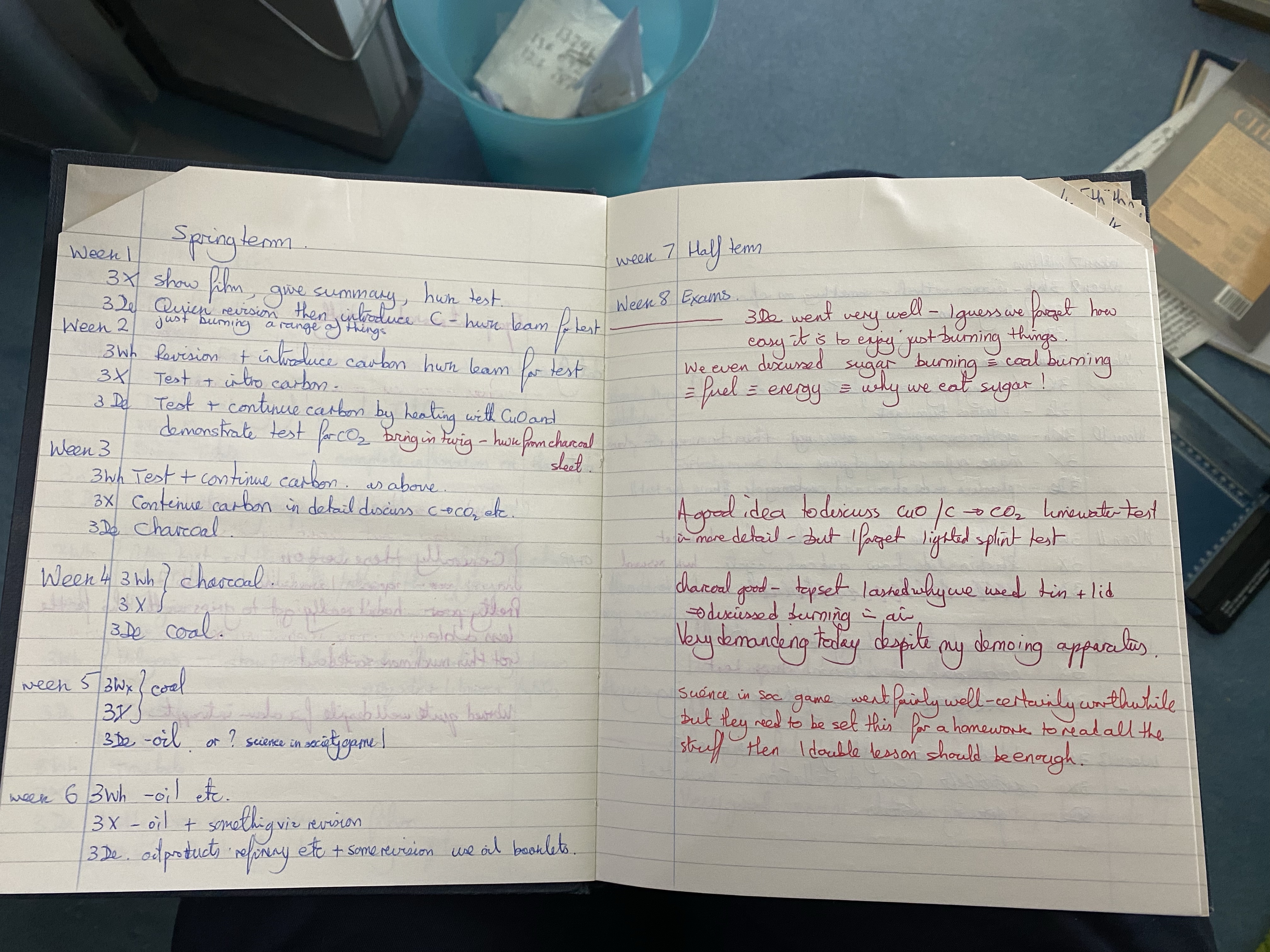
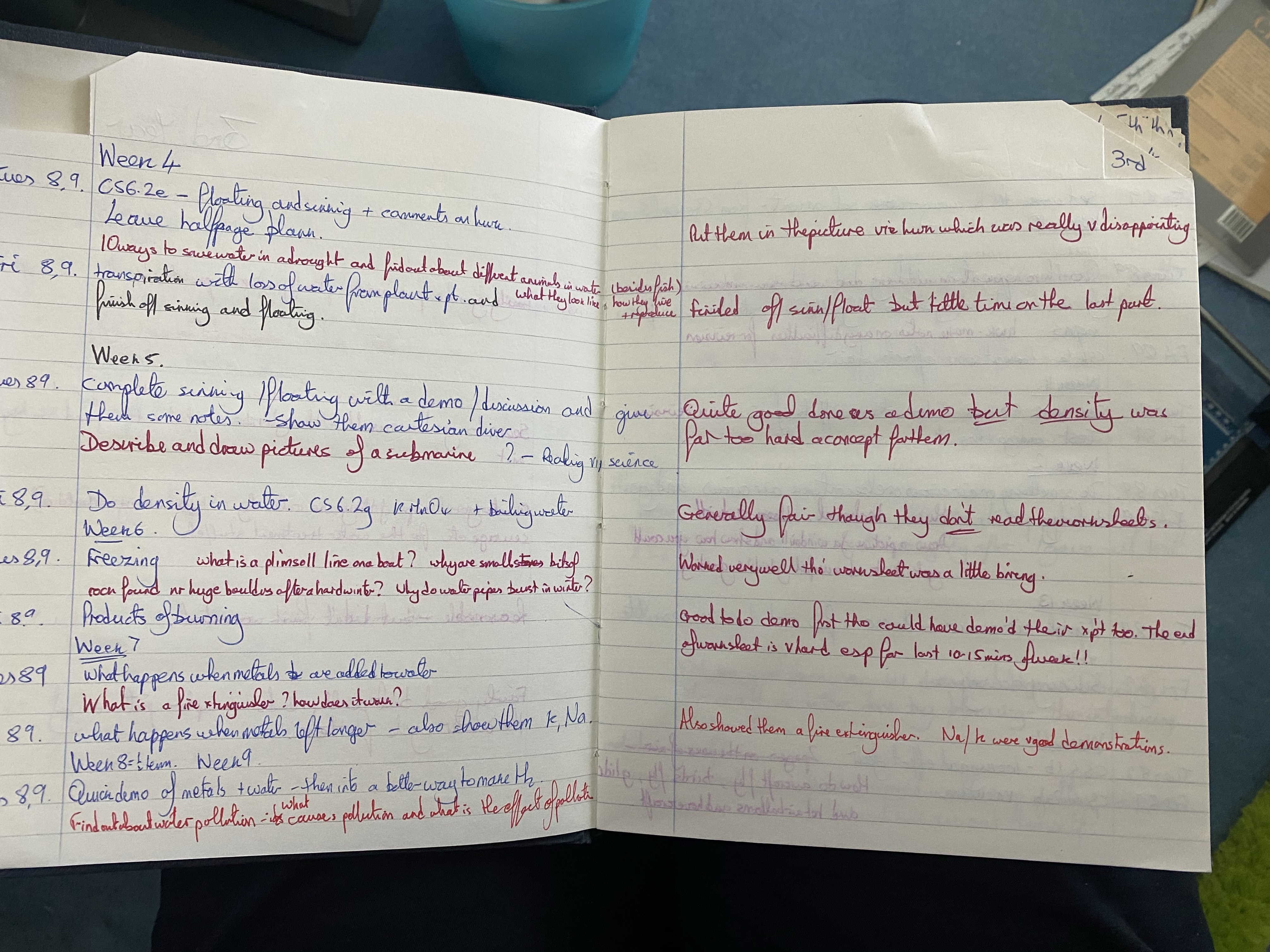
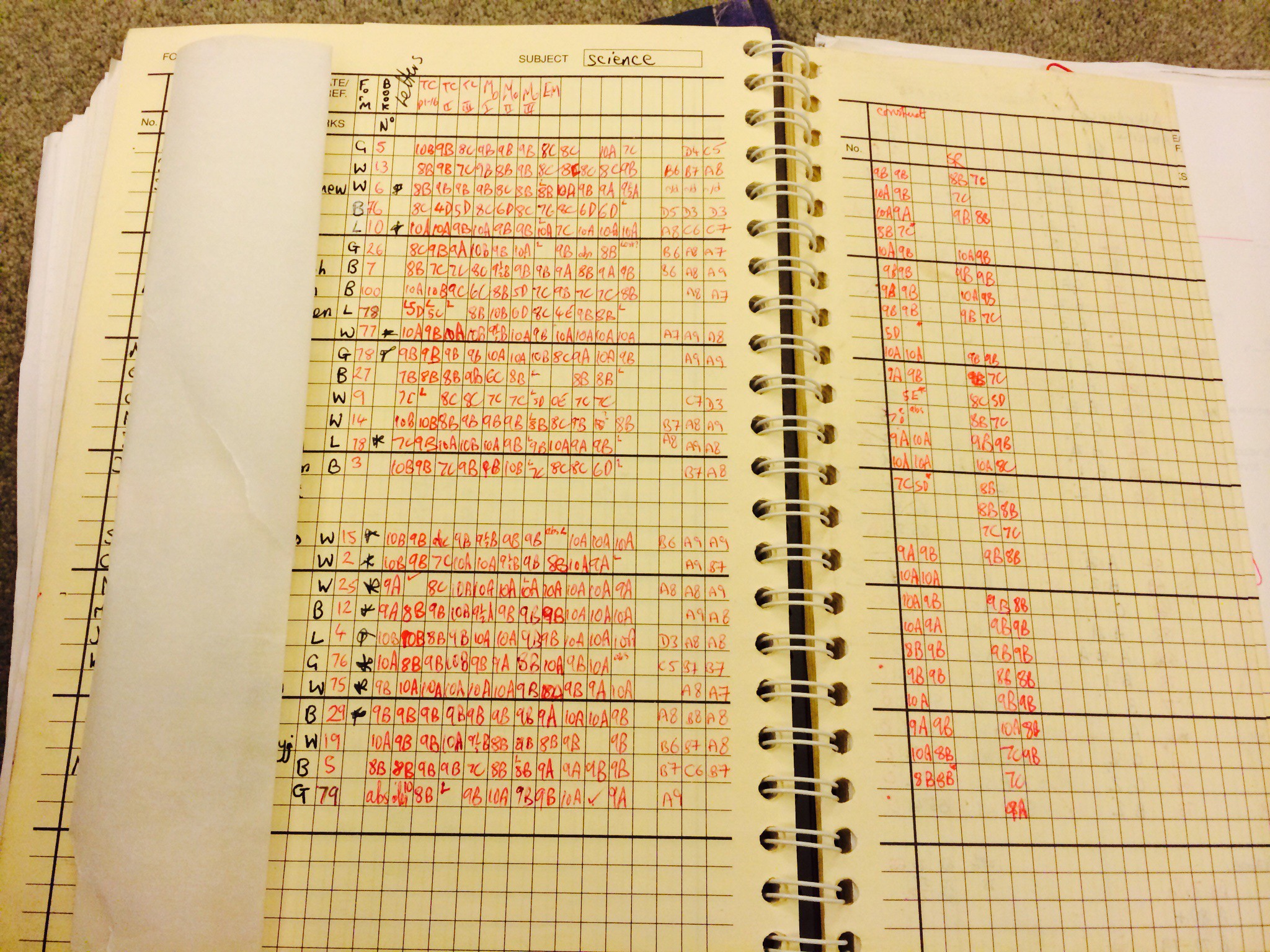
In my early years there were no MATS, not even many INSET days ( preBaker). Toward the end of my first year I had missed opportunity to analyse and think about what I was doing – not a surprise , my PGCE saw about 50% timetable and I was now over 75%. My reflections were brief as the phots show.

I had a very difficult third year class, Y9 – we would have called them low ability. Whatever I did, interesting practicals or care with language, shout or stay very calm, it did not win them over. Discipline was OK actually but they just didn’t seem to learn. Tests often showed deterioration not progress. So one day I asked them who was the favourite teacher and who helped them learn best. Imagine my suppose when with one voice they gave the name of the elderly colleague, an English teacher. I asked her if I could observe her and she welcomed me with open arms.

The class arrived and entered her beautiful room orderly cheerful and keen, they sat down no trouble, they automatically got books and notes out. I was baffled, I mean this was English, activity was limited. Miss S set off by telling them it was spelling test day. Not a murmur, just found their spelling jotters. To honour me they had scientific terms….. out came the likes of aluminium, separate, science etc. they swopped papers, and Miss went through the correct spellings. BUT she didn’t take down the marks. I thought nothing of it. the lesson moved on to study some poetry – even I found it a challenge but they listened, they concentrated, often half the class had hands up at every question. they worked in silence, they asked some clever questions. Towards the end she said it was spelling rerun time and she reran the spelling test, everyone did better (of course). She took the marks down for that test. The bell went, they slowly packed away, no rush to leave, no wild comments, many a ‘thank you’.

As I sat there, a light went on, Miss S had shown them in black and white terms that this class which found learning so challenging, well she had proved they could learn. From initial spelling scores of 2 or 3 correct they finished with 8 or 9 and that made them feel good, made them want more, made them adore Miss S and enabled her to teach them really well because they knew they could really learn.

Teachers finds clever creative, innovative ways to motivate pupils and classes but the best and the lesson I learnt that day is we always have to show, however hard the content is (and listen Chemistry has plenty) with thought and planning, with magic and mystery it is possible to convince pupils they really can learn. This is the hidden challenge and hidden joy of the craft of a classroom. I was indebted to this wise (old) colleague forever.

You are a b***dy teacher!

In 1981 I started teaching and was that new shiny teacher. At the end of my first year, my head of department who was an amazing teacher I was so glad to learn from, asked me to attend a faculty meeting on his behalf. It was a significant meeting because “set lists” were to be handed out.

Hard to imagine a time before a national curriculum when children still chose the majority of their subjects. You might think they could have chosen any 10 or so in any combination but schools were not stupid, so they had little rules like, one subject from option A, one subject from option B plus maths plus English etc. Remember there was no Ofsted but even then we knew what to do to help children.

However, this meeting was to give out the lists of those children who had decided to do your subject in fourth and fifth year or year 10 and 11 in new money. So I went to collect the list of pupils who had chosen O-level or CSE chemistry . It was a scary meeting for me, this was a comprehensive school that not so long ago had been a secondary modern, the pastoral system was a vertical one with heads of house who were frankly formidable characters and I was privileged to learn so much from them including my own head of house Marian Davis. So the lists were passed around the table, hand written and I looked down the list of names recognising some of those whom I had taught. There were of course pupils you were very pleased to see had chosen your subject, in fact these were probably names that everybody would have been delighted to see on their list. Then there was a moment where you looked down to check certain names were missing and yes there were those pupils who I had struggled with and my wisdom at their parents evening to suggest subject X or Y might be better, well that had worked I was quite pleased they decided not to carry on with chemistry (such naivety and inexperience).

Silence dropped over the meeting as people viewed the lists handed down from the deputy head. Then there was a muttering which came from the head of PE, with a bit of sighing, a bit of umming a bit of ‘somebody not very happy’. As that continued one of those heads of house spoke and we all looked at him:

“What is the matter Tony?” said the head of house, a man who maintained outstanding discipline and who we all knew a majority of children absolutely adored.

“Well”, said Tony “I’m just looking at this list. The first time we’ve tried to get PE as a qualification in this school you all know how hard I’ve worked to get this off the ground and I am so disappointed by the names of people you have allowed to choose PE.”

The head of house looked directly at Tony and said “give me an example”

“Well down here is Richard James … he can’t even swim how am I expected to get him any sort of qualification in PE?” I sat there and thought to myself: that’s a fair comment I wouldn’t really like to have anybody doing a serious chemistry qualification with me, who did not know how to handle basic equipment or understand the basic rules in a laboratory or who had done Ok in those first three years at secondary.

However the room dropped to silence …”Tony” said the head of house “ you’re a bloody teacher, teach him to swim”

This was a phrase which rang so true it lasted with me the remaining 40 years of my teaching career.

I was so glad that somebody nailed it, that day.

Whatever we think about the way young people behave or young people take to our subject, do or don’t conform, we are teachers and it’s our job to find a way to teach them.

There’s a kind of question I and many others are asked at first introduction to a stranger in company…..“Oh what do you teach?” to which the answer is …. geography chemistry English etc though the clever answer is “I teach children”. I think that day seared into my mind was that I teach children wherever they come from, whatever their experience, and my job was to do my best to inspire them and …. teach them, to help them learn my subject it was a deeply profound lesson. Thank you Tony and that extraordinary pithy Head of House.

Politicians – party or people?

Seeing so much from Westminster lately I couldn’t help reflecting over my time as a teacher, school leader and director. I have been fortunate to have met many MPs and Councillors.

Mostly local but when labour were in power Graham Allen MP often brought ministers to meet us in Nottingham North. NN is the constituency that historically send the fewest young people to University of all constituencies [Trinity moved from Nottingham North to Nottingham South at a boundary change]. I have always had huge respect for our local MPs – Lilian Greenwood ( whose constituency the school moved into and who always took time to visit her schools) and Alex Norris, sill a school governor and in Nottingham East Nadia Whittome who helped with many projects and programmes and of course my home MP Vernon Coaker although not the present incumbent.

Our own MPs responding very positively to support local heads in the pandemic and taking the trouble to thank them via video or other messages.

Many Conservative education secretaries I’ve met at school conferences (Michael Gove) or through RC heads (Nicky Morgan) or just occasionally a visit to Nottingham (Damian Hinds). Others like Estelle Morris came and spoke at Trinity; Ed Balls listened to our choir when we were invited to sing at the launch of ‘faith in schools’ at the British museum.

Although Nottingham City is a majority Labour I’ve worked with some significant Conservative councillors too including teacher colleagues; some I would count as friends.

So that’s both main parties, local and national, ministers and backbenchers; official business, visits or sometimes campaigning.

To a person they have been polite, thoughtful, and nearly always willing to listen and take time to explain policy or reason. Sometimes I’ve disagreed about their policies including those on education.

The best…. know their ward or constituency very well and keep talking and listening to all their voters (and non voters) whether in power or opposition. They listen to local professionals and many, rather than have a second job are school governors etc , using their time effectively and yes working very hard. They ask good questions and many are extremely good at remembering names and concerns – they are genuinely ‘bothered’ . Of course some have been in power, some have been in opposition

And when in power those who absolutely represent their ward or constituency not just their party are frequently respected and often returned at elections.

Those in opposition willing to recognise helpful policy and to try and nudge and influence on behalf of all of us are respected and yes often returned at elections.

We understand their preference for (and probably their duty for) fulfilling a manifesto but on taking power they change from being single minded party political to thinking and acting for ALL locals. They kind of move on from ‘Party’ to public though with one eye on ‘Party’.

Clearly some never learn and think their job is to run things like they are the only party or people who are right, that they can choose mates and nepotism over sharing fairer representation – diverse views. That they are still campaigning not running government. They ignore public over ‘Party’

Thank you to our local representation when you do ( as you do so often) represent us, thank you for your work on all our behalf, however challenging be it in power or not.

Most of all think of the vulnerable, the disadvantaged, those who struggle who have little power or voice – the neighbour we all should love. And those of you who do – which is a majority on my list – thank you.

China > curiosity, culture and challenge

China – a visit thanks to Access China UK and the Nottingham Confucius Institute and Nottingham City Council

An amazing experience, which would have been incredible and fantastic but was made even moreso or as we teacher’s say “EBI” ( even better if) for the fact I went with 9 great Nottingham City colleagues and we had a wonderful Chinese guide and interpreter,  all of whom added the value to make it totally amazing.

img_9008

Feifei our interpreter at the Ningbo library

IMG_2801

The Ningbo 10 (ignore the man on the right he wasn’t with us!)


\


You cannot go up the Pearl of Shanghai and look over the biggest City in the world (population 24 million) and not think – this is where the future of the world will be centred and so we need a plan, not a Brexit neither an educational plan but a proper plan.

IMG_3171

img_9151


China is a long way away – 5750 miles to be precise or exactly 24 hours from me leaving a hotel in Shanghai to arriving at my front door in Nottingham. But it’s also a long distance away culturally and we so enjoyed discovering just touching upon something of its culture.

It’s a country of the highest population 1.4 billion –roughly 24 times the population of the UK and yet the 4th biggest by area which means a lot and I mean a lot of tower block apartments offices and hotels. Shanghai is the biggest City in the world. (24.2 million). We travelled to Ningbo about 4 hours away, including crossing a bridge of 16km to Ningbo, a City the size of London. It’s busy on the roads but those on cycles, motorcycles or even walking seem to just move at random and hey the cars stop and we saw no accidents. Green spaces are precious.

IMG_9106

Red amber green >GO GO GO

img_3185

Bicycle check, mobile check, helmet -what? Few cares in the world, hoping everyone else will stop.

We enjoyed wonderful cuisine – not like westernised Chinese food. We ate like royalty with exquisite food brought out for us, vegetable dishes, meat, noodles, all kinds of tastes, flavours and textures but not too much rice, rice comes at the end and you are not really expected to eat it. Oh and we used chopsticks all the time. Meals were very sociable, no distractions and plenty of conversations, and no rush, no TV, little wifi. That’s less cultural and more….common sense.


We were very well looked after by our guides, interpreters and hosts, who took us to the most interesting of places from tourist spots, to restaurants and of course to ensuring we travelled to time. In China one is never late. They could not have been more helpful, supportive, informative and generous, as were the hotels we stayed in and all the colleagues we met. And there was a thing – I asked one teacher what she hoped for her pupils “to give them every opportunity to learn”. QED the commonality of the vocation.

The culture is well documented but we were shown honour, respect, admiration and treated with huge kindness and generosity by our hosts. I was delighted to be part of a team that did exactly the same for one another on the trip especially when ‘stuff’ happened and they looked out to encourage, share and support even though we hardly knew each other beforehand. Representing different sectors the conversations gave us all further insight and arguably the best of CPD (one early years, two Primary heads one Primary adviser, four middle leaders from Secondary, one partnership lead and me from the LA). Such enthusiasm to ensure “this works” for our children.


To be a tourist and see the bund and river at Shanghai as well as to go up to the 263m Pearl of Shanghai were something but also wandering the tourist shops and trying to bargain was fun. A privilege to visit the oldest library in China (Ningbo) founded in 1561 and be welcomed as honoured guests was special. More special for us educators as we value our school library or local library and we value lifelong learning. Nevertheless our visit enabled us to consider just how ignorant we were of Chinese history and culture and the potential in the Far East.


What did we miss ? – very little, we had tea, it tasted different but we were ‘tasting’ China. We did not have access to facebook, twitter or google and we had withdrawal but we chatted and we asked questions and discussed education and other matters and we enjoyed the company, well until we hit wifi in a hotel then we caught up on messages via a message/chat system called wechat. We missed traffic jams, we missed litter, we did actually miss a few hours of sleep somewhere along the way. You know something else? We didn’t miss pupils, even English pupils, at that even Nottingham City pupils because we stopped at a service station in this vast country and met 10 pupils from one of our local primary schools – having an incredible time – though perhaps a little tired ( much like us) they were full of the experience.

And so to education and some things I have learned and of course I may be wrong that the whole system looks like this but here are my ponderings :

• Families really value education. Politicians value education. Children value their education. Teachers are highly respected (highest in the world according to this survey). This is a deeply cultural matter and about ethos, respect for schools, for teachers and for learning. We met teachers (sure a small sample but the message overwhelms) full of enthusiasm and diligence, we saw little disruption, and amongst pupils a willingness to work hard and and try your best. There is the extreme high pressures involved in the Gaokao exam but setting that to one side the atmosphere in schools was overwhelmingly positive

Proper resource follows the commitment – beautiful buildings; pride in showing us round. I saw huge sportshall ( possibly 4 full size basketball courts and on the floor above about 30 ping pong tables ( I even played the Principal). Their lecture theatre seated 500. We did not hear any complaint about lack of funding – of course that may be for other reasons, However the conversations reflected on their pride in schools and I was glad to be with a group of Nottingham heads and teachers also proud of their schools. Pay not be better ( not sure really about buying power etc) but most of us would trade a bit for having a culture and pride and a community which hugely respect teachers given consideration and of course good behaviours. [Although my own view is that a vast majority of parents do respect us in the UK – just some politicians and the press don’t always and look where they sit in terms of trust and respect.]


• Teachers teach large groups of 40, and whilst they had nice staff areas to work in, with space to share and discuss, to plan they too felt pressures. It maybe around (only) 3 hours a day at the front but they have no technicians or TAs or other adults in classes. Oh and those evenings when pupils are back in school for several hours studying and doing homework, guess who supervises. Heads and teachers take pride in pupils and in their learning. We heard about two schools at the Bureau sharing speeches and we shared about our two, and common features – pride in the opportunities we offer, in the children’s achievements and the aims and ethos in every school and that included to help our children be global citizens. I asked how the head got his children to work hard – “I don’t have to do anything” he said. Just think what all that means for attendance, punctuality behaviour, background disruption, offering opportunities…..


• I loved the creativity I saw, in particular pride in traditions, but also in creating new traditions. IMG_2883We saw some amazing artwork, incredible calligraphy, beautiful ceramics, others saw sport and music to an amazing standard. We met artists in residence and I was invited to play a computer at a board game, a computer that literally picked up pieces in response to my move and you guessed it – the programme and the hardware created by ….a pupil from scratch.

IMG_2991

a CRT – a what?


I also had a discussion with a Chemistry teacher – he had created something but our interpreter didn’t know the words, we had a small hand held device that translated and he said it was a ‘CRT’ and I said ‘oh a Cathode Ray Tube’ and we whooped! I mentioned Thomson, electrons, Crookes and we needed no interpreter –  science can be such a powerful language in itself but check out these facilities:

img_2996


• Willingness to stay and learn and take every opportunity including boarding, yes boarding for the weekdays because half an hour journey home was “too far”. Long days without TV, without Facebook, without mobile devices and perhaps without immediate family because, they all believe in the benefits from social activity and learning. So we saw some pupils who did more hours of homework in a two days than some of our pupils would do in school in a day. Of course there are concerns about resilience and pressure too.

Hospitality and generosity – we took gifts with us for our school and Bureau colleagues and received many back but sometimes individual  pupils wanted to give us something they had done, some  clearly stayed up to make gifts for their visitors.

IMG_3357

MrMcNeill with a beautiful painting made especially for him

I was privileged to pass as one of my gifts the music of Sheku Kanneh Mason ( an ex pupil at my old school) who also kindly wrote me a personal message for the schools which I had translated – that went down really well. ( thank you Sheku). But oh, we had fun – trying out our mandarin, working out currency, bartering, wondering where we were heading when taken by taxi to a school, getting trapped in hotel door (me trying to metaphorically to “open doors”) – looking out for each other and smiling our way through.


• Education bureau officials welcomed our vision for future work with them, they are interested in what we are doing and especially how we measure impact. How we know our City wide plans and also our school plans are being effective, as well as our regulator (ofsted) view. They are keen to foster further links Ningbo > Nottingham and Nottingham > Ningbo. we have lots of ideas from championing exchanges and learning mandarin through to just a better basic understanding of China and our own Chinese community. To be honest they struggled to understand how our system works if it means a local area does not have any control of schools. Welcome to my world!

It is quite an amazement that across the world they are interesting in learning from us.


IMG_3356My colleagues are now busy working out how to manage exchanges, to plan visits with children and to welcome children here to Nottingham. We are looking at how we can work together across the distances and cultures but with an internet and with colleagues here and our own traditions – Nottingham has a University campus in Ningbo which we visited and so there is much to consider and challenge and much remains to be curious about. For me I am committing to try and open more doors with friends in Ningbo – and not these doors.

A slight rant over ‘Textbooks’ which I love*

“…a book that contains detailed information about a subject for people who are studying that subject”

1 I once wrote a Chemistry textbook – with two other great Chemistry teachers –

IMG_1176

Our Foundation level textbook

not examiners, not academics just plain Chemistry teachers. It was for the so-called less able or foundation GCSE pupils, labels I use but intensely dislike and I learned a lot win writing it and it was a fantastic challenge to help lots of pupils access our subject – especially those who find it hard – which is nearly everyone. It didn’t make us a fortune, schools bought lots of texts for the more able ( have a copy at home have a copy in school etc, but this was for the less able who were in small groups and often weren’t allowed to take a book home). Continue reading

Friday Period 6 – 10,000 hours or 25 Years -> Greatness?

25thannWe said farewells at the end of term just a few, six colleagues we waved goodbye to BUT we also celebrated three reaching a grand milestone – 25 years. Three highly respected colleagues who just completed 25 years at one school, ours, Trinity.


So 25 years ago what was happening – well lots: Labour hated its leader, one Neil Kinnock and the Tories were on a “back to basics” campaign with Mr Major. More important PC world opened its first shop and Sir Tim Berners-Lee invented the world wide web. So schools themselves look very different today but in a way they don’t – we had great teachers then and we need them now and the tools of the trade might change but the craft and trade do not.

berners-lee-570x366

Sir Tim Berners-Lee invented the WWW

When teachers join any school , experienced or not they are still new and these three join five other colleagues who have also completed their 25 years -thats 8 of us nearly 10% staff. It is a very special achievement and I’m delighted that our governors understand that and reward those colleagues for their commitment. It is not exactly equivalent to a testimonial for a loyal footballer but it is a recognition.

It did make me Unknownthink about Matthew Syed’s book ‘Bounce’ which has been all the  rage in schools, and incidentally well worth a read  – I actually met a headteacher who bought it for the whole of his Y11, then moaned that the girls performance improved but the boys didn’t and then apparently Ofsted had a go at one of their ‘gaps’ getting bigger. Thankfully whether true or anecdotal we are in new Ofsted framework. But back to Syed who seems to say put in 10,000 hours hard work and you get to be really good.  Some have pushed that idea for learners maybe coupled with a bit of growth mindset and Dweck. However it got me thinking about teachers – 25 years must be well over 10,000 hours, nearer 18,000  of teaching in same place and I think he is right these teachers have become experts, really good, both at teaching and at teaching in our school and in leading. People who stay a course like that make the school effective these are the characters in my school who have helped understand the ethos, mission and moral purpose and yet also help create the ethos and therefore also help to sustain the ethos. These are the people colleagues turn to when somebody comes as a new teacher ( well and also old teachers and even older headteachers) and when they wonder ” Is that what happens here? Do they really do that?” for better or worse the answer is known.  The colleagues around say yes that is what we do, it is delivered by an incredible level of consistency. They are without doubt respected by pupils, parents and colleagues. These are the colleagues who have  helped establish traditions, activities which over many years we have evolved and some we changed if they’ve not been effective, some we’ve dropped if they’ve been ineffective. We’ve redone ideas and modified them and we have a rich seam of curricular and  extra curricular whole school activities.  We like new and young teachers, don’t get me wrong, we like their passion, enthusiasm, ideas and approaches and we like to learn and try things out but we also have a bit of an instinct as to what works and what doesn’t. As a church school that includes our whole school events like Masses or liturgies but it includes sports days and swimming galas, music concerts etc it includes prize-giving and it includes a discussion such as ‘should  we run prizegiving this way or that way’. What do we stand for, and how do we live that out? Reliability, longevity, tradition, stability, consistency …outcomes – I think that’s what we get.

Our school has done well in outcomes and it is an outstanding school, it’s also very popular with parents and I could not help thinking the contribution of longstanding wisdom is pretty critical.  High turnover at the top of other organisations including the DfE is what we often see across educational landscapes maybe the lack of longevity brings a lack of stability and contributes to an occasional lack of depth or a frequent lack of understanding and frustrations, maybe even a lack of progress, the fact that the standards are not as high as they should be. My other favourite book Collin’s ‘Good to great’ would lead to a similar conclusion. In my early days (80’s) of teaching you wouldn’t expect any responsibility point or pay increases until a couple of years worth of Y11 exam results were under your belt – prove yourself at the sharp end.gd to g8

Fast turnover might make a business more efficient and it might make a company run better but whether it actually gives better outcomes I don’t know,  but one thing I do know is that these long lasting teachers  hold something very special in their hands because it’s from their hearts, possibly their souls. They have invested a huge amount of time and their life  in the school. It might be why our retainment remains pretty high? We always say to young teachers that rules for discipline are important and they must be applied consistently and clearly, when you’ve got people at school for such a long time, the consistency  is probably second to none. However it is also about accountability for me – whilst I’ve written elsewhere about accountability to governors, to the diocese, to OFSTED, to parents and pupils, there is a greater daily accountability which is to those respected colleagues. As well as being accountable to them for day to day decisions, we have to make the decisions together and these are the supportive conscientious peers, if they make a criticism it is a genuine criticism, it has to be heard because they have given so much of their time energy and yes their life to the work of the school. I just wonder if anybody out there really understands the huge effect of stability and longevity. Our leadership team has now completed 133 years at the school 77 of them in leadership.  I can’t help thinking if something of the success of the school is not down to the fact of the commitments and longevity of those people. I do hope it continues and I do hope stability that we enjoy is something that others can consider in their organisations. Oh and PS we bid farewell to an unsung hero in our office, a secretary retiring – after 27 years with us.

imageTwo years ago I came to teach a lower ability Y10 class, never taught any of them before and as I called the first register I had taught an older sibling or parent of 21 of the 26. When I set them their first homework everyone handed it in save one boy lets call him Ryan –

“Your homework wasn’t done Ryan” Ruan’s shoulders shrug.

“Why not?” said I, “should I ring your older sister?”

“No Sir please not Rebecca”

“Ok your older brother”

“No No. He’ll be very cross ”

“Ok I’ll call on your Mum on my way home. Ryan:”

“Sir ……can I give it you at break”

Gosh the job just got a little easier.


For those in a church school

2 Samuel 14:20 Your servant Joab did this to change the present situation. My lord has wisdom like that of an angel of God—he knows everything that happens in the land.”

Proverbs 4:6 Do not forsake wisdom, and she will protect you; love her, and she will watch over you.

2 Timothy 2:2 And the things you have heard me say in the presence of many witnesses entrust to reliable people who will also be qualified to teach others.


Some Questions

Q1 What is the right balance in schools of new ideas and older wisdom?

Q2  Is it possible to avoid complacency in the search for constancy?

Q3 What is your experience of the wisdom of elders?

Q4 A qestion raised after a twitter conversation with Jon Thompson @poachermullen  just how will the profession adapt as it ages and as teachers have to work longer? How do we ensure those wise experienced staff remain enthusiastic and able to do the job? How do we plan for that? Looking after each other? How? Secondments during the career? What do you think?

Why be a PGCE Student Teacher?

By Chris Hall @chrishall1204


contemplationWhy would you want to do a PGCE? It is often a question that gets put to me by many of my family and friends, as well as people I’ve just met, on an almost daily basis. Many people see the headlines in the newspapers and the media portrayal of the teaching career is one which may scare many potential student teachers out of teacher training. So why should people consider it?

Tutors and Mentors

Over the course of the PGCE you will assigned a university tutor who is responsible for the ‘university side’ of the course, such as delivering lectures, seminars and marking assignments. These wonderful individuals are experienced teachers in their own right and are there to support you over the year. The university tutors will also have the opportunity to come in and observe you at various points throughout the year and see the progress you have made since the previous observation.

During the time at school, a ‘mentor’ will be your point of contact at the school and will observe your lessons and from that, help you improve as a teacher. Approximately two thirds of your time spent on the PGCE course, will be within school and intertwined between these periods will be days spent at university which give you the opportunity to reflect upon your progress and practice as well as share ideas with your peers and experienced tutors. It’s safe to say the personal and professional skills you develop over the year is phenomenal!

Peers

imageAs touched upon earlier, other student teachers will play an important role in your year! The friendships and professional relationships you develop with each other is another exciting element to the course, and by supporting and helping each other, the time spent on the PGCE course will go by even faster, on a course in which the weeks already fly by! Another advantage of developing lasting friendships on the course is the sharing of good resources between each other. This will not only help build up a ‘bank of resources’ which you will find useful for your NQT year, but also help to reduce the time spent on creating resources, helping to create a better working-life balance.


The Children

The main reason why people decide to take on a career in teaching is to make a difference to the next and future generations and have the opportunity to share your passion for a subject which you love (and hopefully they students will love too!). It is safe to say that not one day of teacher training has been the same with each day offering a different combination of challenges and rewards. Some of the words students come out with are enough to make roll on the floor laughing out loud and the relationships you build with the students will ultimately determine how involved you get during your school placements.

Surviving

It feels a shame to have to mention ‘survival’ on a post which is littered with positive aspects about doing a PGCE but I feel it should be done, and may give some prospective teacher trainers a few tips!

  1. Leave work at work – try to get into a habit of leaving the majority of your work at school. As a PGCE student you will be on 60-70% of an NQT timetable. This will result in you having an hour or two a day at school as well as time after school in which you can mark, plan or maybe observe a few other teachers. Get a routine, a timetable if you will of work you need to do and make sure it is manageable!image
  2. Don’t try and re-create the world! As a PGCE you are bursting with ideas about how all your lessons are going to be revolutionary in the world of teaching, however, outstanding lessons take a long time to plan and resource and the fact of the matter is you will burn out rather quickly if you have other roles to do on top of that, so as I touched upon earlier, use your peers to come up with resources together, swap them, and make your life (and your friends) lives easier!

I am writing this blog for John after the last day of my PGCE course, and write it with both sadness and excitement! It has been an emotional, tiring and rewarding year in which I have come out the other end a better teacher and a much more resilient person!

So why do a PGCE course? Because there is no other job quite like teaching!

part 3 – from NQT to RQT

This is a bit new, even to me, the term RQT presumably a “Recently Qualified Teacher ( as opposed to retired, or rare, reformed, regular, revolutionary , and hopefully not yet a regretfully ..this could go on.

So with a full year (or maybe two) under the belt, what now?

1 Improve your teaching

You should be confident by now that you can sort out basic issues with learners. Like behaviour and background disruption. these are never going to go away but the mistakes of PGCE/training and even the odd error of judgment last year are put behind. By all means read, research, listen and then try new things but the basics of classroom craft should be learnt. Now ask yourself ” is there a better way to teach X or Y”. Relentlessly try to improve your teaching.

2 Improve the lot of learnerspareto_principle_improve

You have many resources, you might have a Y11 class following  their Y10 time with you and therefore new content but a majority will have been taught once. Get those reflective planners at the ready and where you put *** Must improve this if I ever do it again then…improve it. Oh you didn’t do that annotation, shame! Still revisit and re-edit and talk to experienced staff. You have tried one activity in the classroom to help learners on this unit/topic, so what else might work? Really work out what works in your classroom for different groups: SEND Gand T, PP, EAL after all you know the acronyms and know the children so sort out even better learning experiences for them. You are the true professional now…nearly.

Oh and another important matter, you have taught some of these youngsters before. You know their family a bit but you know them well, you know what they find hard or easy; a richer information than any data number – so really rock and roll in pushing their learning. It will not be easier, if anything it’s harder but it’s much much more effective teaching.

3 Keep even better records

Plan, annotate, add resourceIMG_2499s and spend a bit of time searching for new ones. Talk more with staff and pick their brains. think and plan ahead, ask around, join twitter or the TES forums and networks, get to a teachmeet. Hey throw that weight around and move from good to great!


4 Share

You felt like you were the end of the queue, and you were but you aint no more, so share your idesparkleras of what worked too. Do that in department meetings, tutor team meetings and mostly just in conversations in the staffroom. build some self confidence as a teacher professional in helping others. I had a great RQT colleague a few years ago and she showed me some new resources and ideas….yep teach the old dogs in school, new tricks.

5 Volunteer

You might have a label RQT but most pupils think you are a wise, experienced and knowledgeable member of staff. SO get stuck into some new things this year, take on a bit of responsibility that you are genuinely interested in. it could be extra curricular, sport drama music. It could be within the dept, there is plenty to do: use of data, work with EAL or SEND pupils. help with the planning of a new GCSE or a new  A Level. It might be within the pastoral work? are their seeds of your first promotion in getting to know much more about…..x, then get on with it.

6 Stimulation

The last two years had pressure now it’s you as an autonomous teacher ploughing ahead in the fields to plant in the minds of enthusiasm sat before you. What challenges do you need for yourself? Which classes have had a bit of a raw deal from you? tackle them. Check out the teacher standards, identify your weakest three areas and sort them.

7 TransparencyimageAll of us feel there were things we just about got away with, what were yours and what do you need to do about them? Did you not prepare for a parents evening but fortunately they were mainly pleasant. Did you let a pupil off but they didn’t bring any extra issues? Did the head ask for something and you forgot but heck so did she? What things must you do better?


8 Challengechallenge

Teachers can be professionally socialised by their schools. You have probably been in the same school for a this year and NQT year. There were things surprised you – the Y7 data collection came very early, you wondered why but obviously kept your mouth shut last year. Maybe you jot down a few questions like this to help improve the school. Share with an experienced colleague or even the SLT link you know best. Dont be afraid for a asking a sensible challenging question. there may be a good sensible answer but you might just have asked a really good one.

8 Keep talking

talk-clipart-RTAk5EqTLThe PGCE or training courses (remember them) have structures to support and help and encourage you. So too, NQT year BUT now you have made it to RQT and they all disappear. No more meetings about you it all becomes informal ( save number 9 below). So please keep talking to those you have found helpful or found as critical friends.


9 Performance Management

You now come under the appraisal umbrella. Chat to others about how it works, read the school documents. Do not see it as a threat, just find out what others do, prepare for you first meeting with an appraiser, who will hopefully know you well. Maybe look at what I said in 6 above and ask for some extra training in an area, or try and spend a lesson observing someone to fit the direction of travel you have set. Oh you haven’t set a direction? Shame cos in the rough and tumble of teaching if you don’t choose, the winds will blow you around.
storm