Monday Period 1 – *New Beginnings

In a way it doesn’t matter if it’s a NEW week or a NEW term or a NEW year – or all three in one!

Schools start the new term with INSET and those slightly odd first days of admin and assemblies, but they will nevertheless ring out with their ‘year group assemblies’ and classrooms and numbers of teachers saying “It’s a new start“.

HP mark bkIt is so good we can give a fresh new clean start, some children really need this, probably some adults need it too. There is something special about the first page of the new book, the new uniform, the new shoes. Almost all the new year 7 will have had  a photograph taken at home before they came to school in their new uniform at their new school. Its a new world as well as a new beginning.’

Even staff love their clean, new mark book, new planner and new diary. I wonder when do they become those old tattered friends filled with details of lives? Whilst I appreciate what ICT can do for us, opening a new ‘Word document’ just does not have the same effect. As for my new exercise book – does writing on any page get better than that crisp new page at the front after writing “your name and subject”? In my career two pupils when asked to do this have actually written ‘your name’ and one pupil wrote ‘Fred Bloggs‘ after I actually said don’t write your name’ but write your name for example Fred Bloggs – hey ho I’m such a poor communicator.

photo

Of course it isn’t really a brand new start, unless you are Y7 or a brand new shiny teacher, but it is a new year. It is a chance to start afresh, staff have had a break, and the rhythm of school brings us full circle with a new intake and the school year has rewound to the start once again. I worked outside of education a short while and talking with friends it does not happen so clearly elsewhere, people holiday at different times and the ‘new’ does not happen. I know that some blog readers will not be believers but there is an echo of the church calendar. When a church gathers on a Sunday it’s the first day of the week, and some time is spent reflecting on the last week, seeking forgiveness before looking to the new opportunities in the week ahead. There is no doubt we need to reflect in school. My first teacher planners which I genuinely treasure are hand written with the left column my plan and the right hand column my reflection. A reminder how I sat with my ‘old’ planner to see what had gone well and what had gone badly, to do more of the former and none of the latter. Following the story of my lessons I can see (and still recall) sometimes it worked sometimes it didn’t BUT it was vital in that important aspect: ‘ how can I improve?’

image

A new journey starts here

Back to the new term, new opportunities, new ideas to try and and meanwhile forget the rotten, bad bits of the past, to an extent putting that behind us. This is also a time when we tend to think a little about what is really important to us as we begin a new year, you probably heard some of it in the head’s ‘Welcome Back‘ speech. Pupils often need a new start, and not always at the start of the new school year, a little bridge back into their school community and a new opportunity, probably not too many if the action plans don’t work but forgiveness might be important for some. They too will embrace the challenge of the new year, maybe the new school for Y7 or the new Y10 curriculum they had a say in choosing for themselves, or a very big shiny new Y12 confidently or with a big dose of trepidation starting those A levels ( hey it’s a big jump this new year). Fear and joy, it is just so exciting, well and scarey. Pupils need support and bags of encouragement – some secretly want to take part in the school play this year, learn a new instrument, take up a new sport, or even make new friends or just make amends. Parent and teachers can help them – or hinder them.

contemplationI always found the first full ‘normal’ week back quite hard, I’m not sure what the next class would bring into the room, I got a bit sick of the sound of my voice, the holiday had no bells and now they ring the lesson start and end. Nevertheless it is the start, it’s the beginning of an exciting new journey. Welcome back to the new term and being in the challenges and opportunities of teaching and learning.

And some questions for you to think about in the nouvou world:

Q1 When we and our pupils are so busy how do we find time to reflect?

Q2 I made my Y12 write themselves a letter about how their revision and Y 12 mock exams went immediately after they were over in the summer. We then opened them this week and reflected. What activities do you use to help pupils (and staff) reflect, in the busy routines?

Q3 Is there a limit to how many times can we give a new beginning before we say that really is enough?

and a bit more thinking about the mundus novus in Church schools:

Genesis 1:1     In the beginning …

2 Corinthians 5:17:    Therefore, if anyone is in Christ, the new creation has come: The old has gone, the new is here!

Hebrews 8:13     By calling this covenant “new,” he has made the first one obsolete; and what is obsolete and outdated will soon disappear.

Ephesians 4:24    and to put on the new self, created to be like God in true righteousness and holiness.

You might like to read other posts from my timetable of teaching – each is set out from lesson in the school week, before or after school or at the weekends, appropriate to the time of day. I have also started a  class lists or “set lists” which was to answer the questions: “why be a teacher?”or “why have other responsibilities in a school?” Shortly I am starting a new area about progress from one role or experience in teaching to another with hints and tips about successfully moving on in the job and your teaching career.

7 YBA Chemistry Teacher

In my blog yba teacher I confess to a small white lie or being economic with the truth – teaching is a great job but Chemistry teaching is the best!

[Now I know there are frustrations, problems, annoyances, SLT (hey I’m one) BUT here are my positive thoughts.]

What it is about Chemistry and teachers?  It’s a great subject to teach, though not easy (are any?) so what do I think makes our subject unique , intriguing and beguiling.

It has a great intellectual capacity and challenge. There is no doubt there is a lot to know, a lot to understand, a great deal to work out,  a challenge of how it all applies but at its most basic Chemistry is about ‘problem solving’. From the exam questions to the global problems and from the latter the history of discovery, serendipity, heroes and well a few anti-heroes too, some absolutely lifechanging discoveries and developments and some we are overwhelmingly embarrassed about. but it generates huge curiosity. One of my first ever lessons with a brand new shiny y7 and I added acid to indicator, then added alkali and as it went from red back to green a small child open-mouthed, staring from a silent audience in my lab said “bl**dy hell that’s amazing” and the whole class and me gasped, his face said it all, one of astonishment and yes we had a word about his words. but who couldn’t read about our subject and not be curious. There are patterns and themes and exceptions and rules and maths and observation and theory and practice, what could be more intriguing?

image 2(3)

For me the real highlight is that it has great stories : of discovery, of changing the world for the better, of poison and intrigue, of dedication, of enviable cleverness, of battling against the odds. Stories of people (too many to list) and materials. it has a great history, it’s involved in culture, it is …everywhere. If you are a non chemist reading this get hold of ‘Chemistry world’ from the RSC in a local library and I defy you to read two or three copies and still not agree: medicines, dyes and paints, fuel, energy, food, agriculture, materials from plastics to metals, detergents, cosmetics, …..just soooo wonderful. I might even claim the history of mankind is driven by Chemistry, you can’t fight a battle against warring invaders in a bronze age without..bronze, and you can’t fly aeroplanes to escape without Aluminium. I can only tease you here, otherwise it’s a book on the way!

image (3)

Resources: the subject has come along way in classrooms since I learnt in the 70’s from a textbook and the occasional copy of “New Scientist”. There are fantastic books and blogs, magazines and great stuff for children like the wonderful “Chemical Chaos” We have great writers like John Emsley, how could you read anything he has written without being desperate to share the story. But it creeps in elsewhere in Physics and Biology from DNA to solar panels…we are here, there everywhere –  #loveChemistry. I have taught Salters’ Chemistry since it was first piloted in the 1990’s but if you don’t teach it, get the Chemical story book and I’ll refund your money if you don’t make good use of it

People: The subject is a living one and so we study past, present and future at school and then there are graduates, PhD’s  and post docs, researchers and professors, retired Chemists who blog and write and tweet, there are Uni researchers sharing their research. Check out the RSC Learn Chemistry  and make sure your school is involved. If you are not on twitter get started, and follow the likes of…actually it’s not fair to mention a few here, there are so many keen to help and half the fun is finding them on twitter, some may even retweet this blog. In due course I might get around to listing the bloggers and tweeters. Alternatively search for #Chemistry or #lovechemistry. There are also the phenomenon that are twitter chats such as #asechat. Over my 30+ years I have had the great genuine pleasure of meeting all sorts of academics, industrialists and educators. They have always been willing to share and help and support. I’m not sure I have capitalised on this but it can be done. My school had a wonderful industrial link with Boots locally for many years when industrial visits were part of the specification – Boots were hugely helpful and my students found the visits to….essentially pipes and pots…fascinating. How? The whole visit was around solving problems in production of Ibuprofen and hey….they were good. [see ofqual there is more to teaching than assessment ut your is a critical role!]

Web based resources. In recent years we have seen a growth in resources on school websites and university websites and fantastic links to be pursued and followed. Organisations well preeminently the RSC but also the ASE. Local sections, paid staff and volunteers, publications and websites and the most wonderful CPD.There are foundations like Nuffield, organisations like CIEC, NSLC and University departments too numerous to mention, my experience is that these people are always willing to respond and support too and I’ll add in any more if you let me know any obvious one’s omitted. I have though to mention @RSC_Eic because their website and magasine has a special place in my work but it is always an inspiring read with something to make you think and something for you to try and use. stuff for students, events to take students along to and great ideas to use with them. I can’t leave this section without referring to videos ( hey we watched the Christmas lectures in my day) and of course youtube has great links. You really must store periodic table videos from the University of Nottingham in your favourites but here is my all time favourite video all the way from 1947.

Practicals: From demonstration to class practicals through to investigations. I still love demo’s, yes a few bangs and a few ‘ooh agh’ colour changes or explosions but also the finer details, demonstrating a titration properly and seeing youngsters learn and do their own, aiming for really good results. Class practicals, especially if we keep them a little open ended and coax some extra curiosity. No not those we have to use in coursework or controlled assessments, just great practicals. If you get a chance make use of local companies or Universities willing to show/use some of their big kit too. I am still scared when we start our Investigations with Y13. Perhaps ten or twelve different experiments over 3 weeks, carefully planned, executed only to find this is Chemistry and sometimes doesn’t do as it should, written up, analysed and evaluated and all that for 90 UMS, and they enjoyed it. Not sure where this is going in future Ofqual!

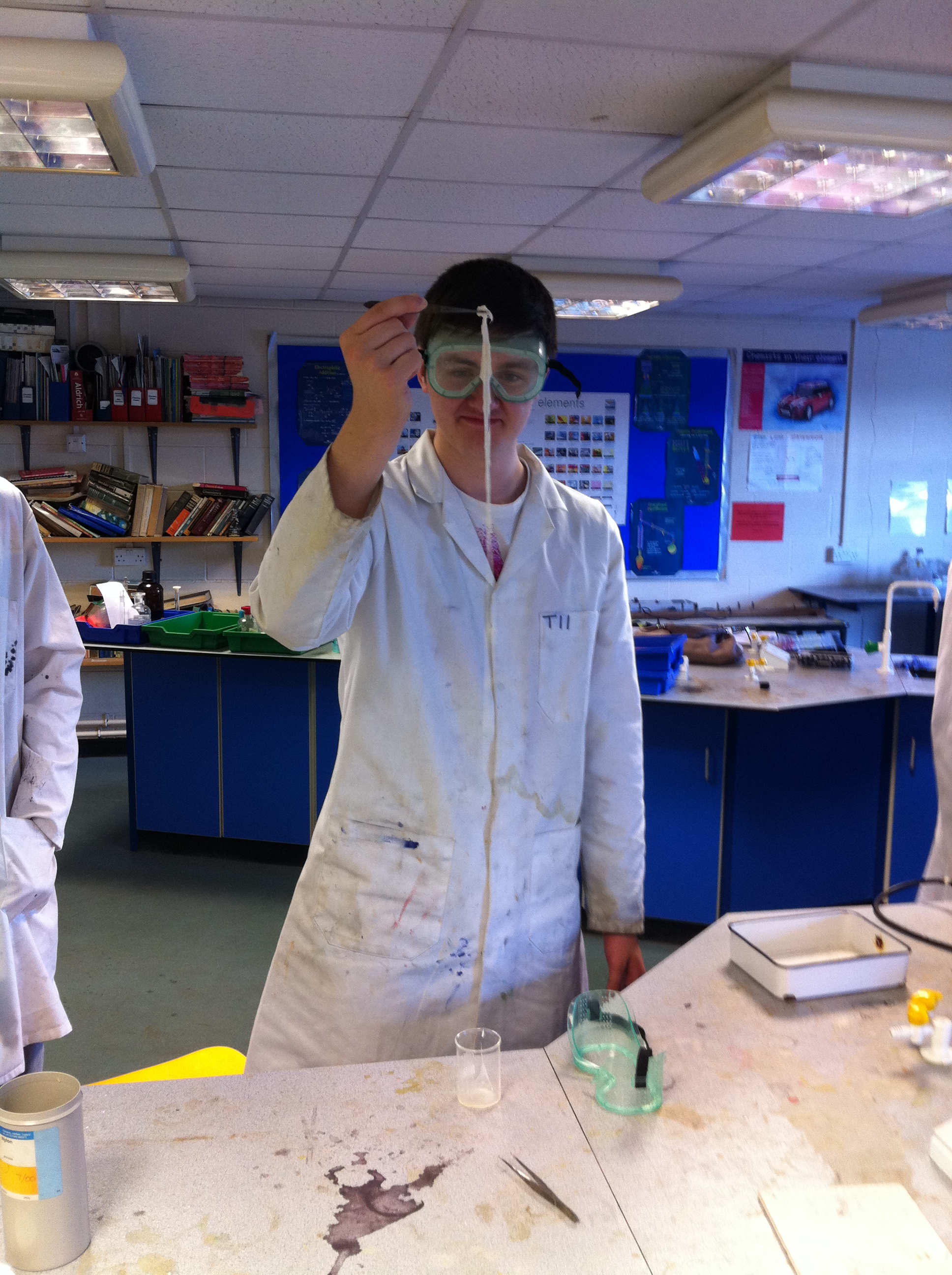
Making nylon

Exam questions ( well applying Chemistry) I mentioned intellectual curiosity and once pupils have learnt enough basics ( although my University tutor claimed that took 3 years as an undergraduate) we can then solve problems. I refer readers to OCR specification assessment materials, they are a major challenge as pupils look at their problem solving in a new context. All the exam boards have stuff like this. You can’t really look at solutions to an ozone crisis without understanding bond energy. You can’t look at fuel replacements without a deep knowledge of thermodynamics and despite the interest in a manufacturing process you really do need to get a good grasp of equilibrium and kinetic Chemistry. I recall one bright A Level student say to me after their exam “Sir that was really hard, you never taught us about poisoning deer” which was true, the derivation of course was Arsenic chemistry (also not taught but worked from the pattern of N and P). I love those new and different contexts and I always reckon one of these young pupils might just be able to replicate photosynthesis in a test tube one day.

Frontier stuff: Yes we can share the here and now, sure we have to cover atomic models established back at the turn of the last Century but we can look at the major modern progressive stuff too:green chemistry or clean technology, computer modelling and yes we can read about whoever won the Nobel Prizewinners in Chemistry (another brilliant website) and we can think why and what it might mean.

Chemical education research it’s not just a subject with diverse, interesting and challenging content from the worlds of Industry, academia, research, Art, culture. But we do have proper chemical educational research, and like the content it’s not just a UK tradition. if you need a starter, try this site, but do look at stuff going on in Higher Education too as much can be brought down into secondary.for example there is a lot of discussion going on about ‘flipped classrooms’ bet we can draw from that. ( oh and they might learn a bit from us too). So lots of wonder CPD and commitment, including the RSC’s latest paper on Chemistry teaching and I added a positive but challenging voice in a recent endpoint, whatever happens the commitment is there for the profession.

Rare orchid, smells of chocolate, makes the milk of cows that eat it turn blue!

Rare Swiss orchid, smells of chocolate, makes the milk of cows that eat it turn blue.

Activities  Pupils do love their practicals but we are richly blessed, we can stimulate great data analysis, we can develop and try out micro scale practicals, we can turn to molecular and computer modelling. Back in the day I tried so hard to think in 3D and I think my inability prevented my progress but then along comes molymod models and then computer graphics. This will light up the Chemical world. I have a few old OHP I drew to explain electrolysis, atoms with a bit missing (cations) and atoms with a little extra electron being picked up and I flashed these up quickly to make a video. Laughable now as we can see so many animations, we can even do ‘play’ experiments in school altering the temperature and pressure etc of complex reactions or processes.

photo

Ah – the Element of surprise

Careers– I think Chemistry qualifications show some sort of standard even in this ever changing time. Our pupils are well served by a GCSE in Chemistry, an AS or A level and BTec’s in linked areas ( though I wish the vocationals could be sorted properly!) and of course a massive variety of degrees and linked degrees. But we chemistry teachers can get great careers too, after all these teachers are good problem solvers ( theoretical and practical) they are good communicators, they know about research principles and hopefully they are a touch eccentric and they share great good humour: need I say more! Interestingly the fantastic Chemistry teachers I have met and worked with, very often still think of their classroom lessons as the highlight, they really do #lovechemistry.

Colleagues – I work with and have always worked with great chemistry colleagues, sharing ideas, learning from each other, thinking how to improve what we do or frankly working out how to use some new spec or new assessment model to advantage. Just discussing Chemistry with another person interested in the world of Chemistry, is frequently uplifting.

Students– best bit of the job, trying to teach them, trying to help them learn, coping with their lows and highs, getting them through mocks, tests, exams, answering their questions, moving their ideas, challenging their understanding, helping them solve problems, sharing the stories, working out how to motivate this one, challenge that one and support them all. The best being when they get it, when the proverbial penny drops, when they see the bigger picture. The other reward when they enjoy chemistry, decide to choose it into y12 or y13 or HE. Especially those having chosen it as a ‘ best of a bad choice’ who find they too #love chemistry and then think of HE or employment in the world of Chemistry. Seeing them sailing off into the Chemistry sunset….or sunrise 🙂

So if you are a prospective chemist wondering about teaching at school or in HE…go for it, you won’t regret it, and if you are a Chemistry teacher in the broadest sense:

Q1 What else do you think makes it a great subject?

Q2 Are there other things professional bodies could do to help us?

Q3 What obstacles that stand in the way do we need to shift?

Q4 How else can we share our enthusiasms?

IMG_1235

7YBA Teacher

[Like all set liststhis one may change by those annoying SLT i.e. me; Mainly if you reply or tweet me anything forgotten.]

Some of the best things about being a teacher:

You get to work with some great pupils. those who want to learn are in the majority, they are keen to hear from you, your knowledge and keen for you to help them understand, to apply knowledge and yes sure to pass exams. In secondary there is a massive variety of ability and also of ages. There is a huge difference between a y7 and a Y9 and a Y11 pupil. That is a major challenge. At the heart of the job, good relationships with your pupils, and an opportunity to open their minds, challenge their minds and do much the same for yourself.

You get to work with some great teachers. People of wisdom about the school or about the job. Hey and you need to aim to be like that yourself one day. It is a profession full of intelligent and clever people, but the best are the witty ones! you will also get to work with great support staff, secretaries who understand you can’t speak to a parent just now, exams officers who sort your error, and ICT technicians who we call “superheroes”. Those many interactions are, in the best places full of witty banter.

You get to share your subject. That means you share your passion, enthusiasms and you learn about your subject. It is difficult to teach a topic without mastering in so whatever subject you love you get to love it more.

You get a specification or a curriculum to teach. You get some guidance from schemes of work ( which you can contribute to) and to try to fathom out the best way to deliver the objectives. Lots of colleagues will help you and also be willing to learn from you. You need to learn to make good use of resources

You get to be creative./ OK, so there are Powerpoints and worksheets but there are also activities and practicals and a massive host of ideas. Some are in your school, some on the internet and some in your head. You can also contribute to that wonderful pool of resources. Hey and you get to share your humour.

You have to look out for data. Yes, you have to mark books and assess work and get depressed about mock results. But mostly you use any data to help you engage with pupils and help them learn and improve. You do really assess for helping learning. In fact other data…forget it. You get to see the wood for the trees and the trees in the wood, individual pupils progressing and growing up, under your guidance.

You probably get a pastoral role. Looking after a tutor group is another twist to the wonders in the job. Checking they attend, they have the correct kit and uniform and do their homeowrk. It might sound a routine but there is nothing better than helping youngsters in your tutor group. They have bad days or bad things happen, they have birthdays and good things to celebrate – you can be involved. They get pleased with a report, they get disciplined, they need someone keeping an eye.There will be some pupils who your involvement, helps keep them engaged and helps see them achieve. No one forgets a good tutor. You’ll meet them later in life, you will.

Professional support. Well there is CPD and courses and INSET stuff but there are also subject associations, twitter, blogs, teachmeets. meeting colleagues in other schools hearing their moans snaffling their ideas.Though for some, nothing better than a conversation in the staffroom at the end of the day

You get a career. You can move into all sorts of areas. You might get interested in SEND pupils, or EAL, or gifted pupils. You might get interested in careers advising, pastoral work, running a dept or in assessment and examining, or writing books, or educational research or teacher training…the list goes on. Develop your interests

You get to do some extra curricular stuff. Maybe your own interest or a hobby well you can share it, even if it is a bit obscure, but it might also inspire someone at your school. The obvious, run a football team take the basketball, run the orchestra, organise the drama, help with the technical stuff. But there is also the yoyo club, the chess club, organising the charity fundraising…..nothing will go unnoticed, well it might be a Head or SLT ( it shouldnt) but it ont by the children neither their parents

You get to work as part of a team. As a subject teacher you are in a dept, others to chat to about your subject, about your class, about their progress. Stimulating, challenging and usually supportive. If you want you to can learn a lot from this group. But you are also in a pastoral team. Watch and learn how well some staff deal with those apparently difficult or vulnerable pupils

You get to work as an individual. Frankly when the classroom door closes despite observations or even cameras, you are the adult in charge of the learning. It’s your room, your timings, your decisions about following the plan or abandoning a bit. It’s where your reputaion is made and respect is created. You get to perform, to act, to entertain, to control, but most of all to teach, to inspire, to help children learn and progress and get a qualification and begin to become an autonomous, independent confident young person

Magic moments i got that, ive understood that, Ive got this right, I can do this. A smile a look a decision to do your subject in options or post 16 or even in HE. A parent thanking you, a pupil thanking you. A pupil achieving their dream. Lots of ‘little lights’ going on, and many ‘Oh Agh” moments.

You get support (usually). Support from colleagues from pupils, from parents and from your local community, the village the district, or if a faith school it might be a parish). Usually local people and businesses are supportive, they might employ your pupils or take them on work experience. Teachers get a good press ( try being a politician lawyer, estate agent or banker) we are trusted. Your view might actually count, in a classroom and community if not in whitehall.

You get paid. The pay isnt so bad ( unless you live in London and/or want a lavish lifestyle) the pension is OK but might be deteriorating. The holidays are good but maybe not quite as they appear from outside the profession. Despite any moans most teachers enjoy going back to work.

Hey there are drawbacks: you need stamina; despite all your effort a class gets you down; pupils can behave badly or sometime they behave well but just do not appreciate your effort (on the face of it). Leaders sometimes don’t help they interfere, then annoy, they rearrange things, they tell you off. Some parents…well perhaps the less said the better. Governments interfere..let’s say even less about that. Resources can be short in comparison to a neighbour school or another dept.

You will have avery busy days. Very intense and lots of interactions but you will never be bored. There are no two days the same, and frankly no two lessons the same.

It’s a great job, lots of us, old and young still #loveteaching

If you wish for a glimpse, take a look at the easy to read stories of life at a school (Trinity, mine)

338

Trinity Lower courtyard

Thanks for all the tweets and messages and for version 1.1to the following

@Mando_Commando
@Ramtopsgrum
@Ngoalby

Monday period 5 – A simple and profound lesson to learn

If you are hoping for inspiration for teaching your Monday period 5 jump to the end. My Monday period 5 is my worst lesson. If you are an ex pupil reading this, I do apologise, I can explain. If you are a present student get off this blog and back to the work I set you. When preparing for my week, sorting assemblies, pastoral work for the teams I lead and critical admin or UCAS ref then marking and lesson prep etc invariably there was not enough time. I am a professional, so usually got Monday 1 and 2 and even 3 or 4 sorted but 5…it got left, drafted but left. After all I am SLT I have non contact and so that lesson could be polished in my free. What free? Why have I never ever learnt that my free on Monday got hijacked, maybe cover, maybe someone needing to talk – a sixth former wishing to quit, drop a subject, change subject, or a teacher…… with bothers, with worries….but I never learnt and end up with my meagre prep and the 10 m walk to the lab as I get to Monday period 5. Apologies all round. Thanks timetabler this year first ever no class Monday 5.

BUT one thing got me through, it was always on my mind, or in my mind, in fact in my soul and it goes back to my very first school and the end of my first year of teaching. However I recall it today because it is the school holiday.

Yesterday I arrived in Eastbourne or as my Dad would have said the seaside. As I took an evening stroll, I thought of my Dad and many happy seaside weeks as a kid and one profound ritual. As soon as we arrived we had to go to the beach. Whatever time of day, whatever needed doing, before any bag was unpacked, we all had to go to the beach and paddle in the sea. Just paddle in the brine, Dad thought it was good for us but it was a significant moment it meant the holiday had really started. I did that here in 2014 after arriving and I thought of my Dad, and his ritual is now mine and the holiday has started. Then as I strolled the sea front I though of other significant moments and rituals and I remembered a profound moment that still inspires me the teacher.

image

Back in the early 1980’s I had just completed my NQT year, woop woop. I had survived, I could teach, pupils could learn and most pupils even behaved themselves, some enjoyed my lessons, and I quite enjoyed the job. More importantly I learnt from great staff. Many of us might think the pressure of change under Gove or other recent SoS is worse than any other teacher has had to face. I am no Historian but the people who I was learning from were awesome staff. Some had started work just after the war – so stop and think of the changes from 1940’s to 1980’s not just in Education (qualifications, comprehensivisation, secondary moderns, the 11+, ROSLA, graduate teaching, corporal punishment, expansion of primaries, free milk (ohps) etc etc) but think how a grey 1950’s society transmogrified into swinging 60’s and these were the people managing pupils, teaching and learning throughout. I learnt so much. Miss D my Head of house who kept order, not just pupils but staff. Mr H in charge of special needs pupils: every single special needs youngster stood out, their manners, their impeccable behaviour, their progress, their employability, their reliability and willingness to help out even me and I didn’t even teach them. Mr L, another Head of house, formidable – he would never have needed a ‘cane’ that would be an affront but no one ever refused to change when he spoke to them, teacher pupil, even SLT! None of these were PGCE graduates all were wonderful teachers who got the best of results (in the full sense of the word). In my tutor group parents would ring me , the NQT and ask me to get their children dropped several sets just to have Miss D teach them (she never taught O Level!) I wanted to be a teacher to make a difference, to help young people learn my subject and to help them aspire, aim high, and there in my school these wise sages were doing that day in day out, and I was privileged to live with them and learn a few tricks from them.

So my profound moment – the start of the summer term and endless invigilation, no lesson prep, no marking but walking the lanes of exam desks. My HoD and I had been busy deciding what to teach and how to teach ( sorry present generation, this was what the job used to be like) and he asked me a favour. Would I go to the Curriculum meeting for him, he was unable to attend – he had OK’d it but this was the meeting options were given out, we needed the list of those choosing (opting for) Chemistry. I went along scared, rightly so as the pastoral giants took their seats ( hey and they were their seats) and the departmental academics arrived, then deputies and the Head. Top of the agenda the lists: “take them away. let me know any major issues” said the deputy politely. Just a few minutes of silence and nodding heads as the lists were checked, a few sighs of relief from me as most had chosen a Science (only Maths and English were compulsory and that a school thing I recall). But then the moment I’ll never forget. The Head of PE Mr K was clearly sighing, tutting and not happy. The Heads of House never missed a detail.
“Whats up Tony?”
“Oh nothing really”.
“No go on what is it?” Mr L didnt understand ‘nothing really’.
“Well” said Mr K “you all know we are offering CSE PE for the first time and we have worked hard on the resources and curr plans but I look down this list and it’s ..well it’s just depressing.”
“Why is that?” came a curious response from the Head of House.
“Well, if you want an example, we have Jim Jarwood and he …….can’t even swim.”

So as I watched carefully for the reaction, I passed sympathy to Mr K. My HoD and I wouldn’t like anyone pitching in for Chemistry who hadn’t shown some competence in Y9, and someone cack handed, dangerous or unable to sit still.. so what was the reaction:

“Tony” said a smiling Head of House rather cutting the atmosphere
“Yes Bill”
“You’re a bloody PE teacher Tony, teach the lad to bloody well swim.
Next item…….”

image

I can’t remember anything else of the meeting but that moment struck into my soul, like my Dad’s holiday ritual. So whenever I am a bit uncertain about my lesson, or facing a cover in French I just remember those words. “Mr Dexter you’re a teacher, teach them.”

Some questions to ponder;

Q1 We often reflect on our lessons and pedagogy but what are the profound moments in schools which have influenced you?

Q2 We might feel the political agenda hinders or even prevents the ambitions we had about being a teacher, does it really?

Q3 The school machine is oiled by the quality of relationships, which people do you seek out for sage advice, and wisdom? Oh and one day will others find you doing that for them?

For those like me working in a church school

Ephesians 1:16
I have not stopped giving thanks for you, remembering you in my prayers.

James 3:13
Who is wise and understanding among you? Let them show it by their good life, by deeds done in the humility that comes from wisdom.

Daniel 1:20
In every matter of wisdom and understanding about which the king questioned them, he found them ten times better than all the magicians and enchanters in his whole kingdom.

Friday Period 1 – Simple? Not really

Mr J Dexter's avatarMr John Dexter blogs about school

Schools are not simple places

There is a cynical view amongst many teachers that there are many experts on education because “we all went to school once”. A particular and probably unfair criticism often made of Secretaries of State, after all they do get to visit schools, just maybe not enough and with a very specific view and not the view from the chalkface. I’m not sure it is true but there is an impression that some Governments and some politicians and maybe others think schools are simple places. Along the lines of:

  • Teachers prepare lessons (same year on year) deliver lessons (to a class) and mark the work produced.
  • Teachers teach to a specification or syllabus.
  • The children learn (or do not) and pass (or do not) exams.
  • The curriculum is clear
  • The best teaching methods are very well known and agreed
  • Assessment models are clear and effective ( oh hang…

View original post 1,801 more words

Friday Period 7 – A worthwhile job

Twitter, blogs and some newspaper articles are failing to balance the good things about the job of a teacher as well as the pressures, and I think I’ve done that in my blog too, so this post is to remind me and others what a great job it can be.

This time of the year I seem to be at various events where I come across ex pupils, including some such as parents (who I once taught) of our new Year 7. It’s also a time when emails drop in from those graduating with news of degrees, of firsts, of jobs and “please can you do a reference?”If I had a facebook account I might keep up better but I might never get any work done.

Friday evening and I had an invite to a party – not really me after an exhausting week but out I went. It was to celebrate a local company achieving over 10 years of business, and it’s run by a former pupil. I went with a few other colleagues and could not have anticipated such an uplifting evening, not least the gratitude which greeted us just for being there. During the evening several others ex pupil peers were there and I caught up with their activity but they just wanted to talk about school days, for some almost 20 years ago. Another little generation appeared through a connection and off we went again as they enquired about teachers, reminisced about their time. Spookily it was almost a self assessment reflection : what I did well, what I could have done better, what I am working on….

I was interested that they were still looking for some approval too but it was genuinely lovely to see them, to hear about their families, their work and their lives, and of other ex-pupils too To hear they made business decisions seriously influenced by the ethos we tried to share, was quite significant too. I recently had contact with two others now involved in the media, they still call me Sir, they still laugh about the funny moments and they have a huge pride in their school, oh and they pull my leg. I’m not naive, there will be many ex-pupils not in touch, who hated me, hated school and may or may not have been successful, I might never know, but what I do know is those I bump into remind me of why I do the job I love, even those whose life took them in a different direction.  Oh and I do know it’s not all down to school, schools are complex places, so too are people, the influence of family and friends and their own integrity are often much more important, but we play a part.

Two other ex students are both involved in teaching and they wanted to reminisce but they also wanted to pick brains, each other’s and mine. How sweet I actually thought, you still want to hear my ideas, my thinking, I would have thought you had more than enough of that – not so!

So fellow teachers and especially those starting in the job, or going on as NQT’s or moving into the early years of the job, my post is a bit of an antidote to the Guardian’s “Secret teacher” oft complaining ( sometimes rightly) of the job. Sure there are issues, battles, problems, massive frustrations, stuff out of our control BUT the job is about education – educare “lead out” and meeting older pupils after Uni or after a period of work or after parenthood and seeing them having blossomed and fond of their old school (and their old teachers) does make for a reminder that the job is worthwhile.

My two ex pupils are now in education ( trainer and teacher)  both had sat in A Level Chemistry with me, I can recall both as clear as if it were last week, the marking of their coursework and the stuff they did which annoyed me, and getting them to listen, dragging stuff from them as we always do (don’t we?) feedback and probably a hundred other things I did whilst teaching them hey they are so worthwhile. We often say we look for pupils to ‘fulfil potential’, we have all handed out results at KS4 or KS5 which have seen the pupils dream from Y7 come true ( even when it felt a very long way off in Y7) and to see them now…..well it made sitting down to that work then seem all the more worthwhile, and spurs me on to the next tasks I have to do too.

So the purpose was to remind me and you, reader, what a great job teaching is. Oh I know this is all anecdotal there is plenty more to notice:

  • pupils who manage to learn
  • pupils who progress and achieve
  • pupils who turn things around
  • pupils who take responsibility on
  • pupils uninterested in a subject becoming fascinated or curious
  • pupils who discover and exploit talent
  • colleagues who make ideas work……my list could go on but it’s Friday 7: forget school and enjoy a beer. Except that…..school, well it just never really goes away.

Some questions to ponder

Q1 What are the long term rewards of the job?

Q2 Do we share the better aspects, the philosophical reasons why we do this every day, to encourage the next generation of teachers?

Q3 Give me a child until they are seven……and I will give you the (man) adult. Discuss!

For those of us in a church school

Luke 6:40

The student is not above the teacher, but everyone who is fully trained will be like their teacher.

Ecclesiastes 7:27

“Look,” says the Teacher, “this is what I have discovered: “Adding one thing to another to discover the scheme of things

Proverbs 3:1

[ Wisdom Bestows Well-Being ] My son, do not forget my teaching, but keep my commands in your heart,

Tuesday Period 5 – Accountability, Responsiblity or Pressure?

“Accountability”

1. the state of being accountable, liable, or answerable.

2. a policy of holding public officials or other employees accountable for their actions and results: a need for greater accountability in the school system.

Responsibility

1 .the state or fact of having a duty to deal with something or of having control over someone.

2 .the state or fact of being accountable or to blame for something.

3 .the opportunity or ability to act independently and make decisions without authorization.


I have been doing my round of department audits. These annual meetings are essentially a report from Heads of Department about what they have found in ‘checking’ on the work of their dept. An accountability measure, so it made me wonder again – just who are we teachers accountable to and responsible for? However after writing this I wasn’t so happy with the posting and was pleased when @Chemistrypoet tweeted me about responsibility and accountability and this made a bit more sense. Well you can see if it does so:

1. Pupils. First and most important I am responsible to my pupils. It’s why I took the job, I hoped to help them learn. I think about the class, the schemes of work, the way they learn, what might be interesting or exciting, difficult or straightforward. It’s these people I want to help succeed, to learn, to enjoy to be challenged and to grow. I worry about their exam results. There is some accountability too – depending on exactly what sort of pupils voice we use – smart ones methinks!

2. Parents. I am obviously accountable to parents. I send them reports, I talk to them at parents evening and expect their support if I need to call them over any ‘problems’. They occasionally remind me of my job – in the nicest way of course. There is a big responsibility here, whatever might be said we are in so many senses “in loco parentis”.

3. Myself. Maybe my conscience but accountability to my own aims and standards it sounds a bit grand, maybe pompous but it is true. I chose the job to spend my energy and effort and any talent I might have, delivering learning for pupils, trying to inspire, inspire in Chemistry but sometimes just inspire them to get stuck into life. I often ask myself if I am doing a good job and like most teachers wonder what I might do better. I prepare a lesson but then seem to dream endlessly about how I might improve it, and do much the same the next time I have to teach the lesson.

4. Colleagues. This is just staff in general. We talk about school, classes, pupils, education, Mr Gove, policy and yes about football or gossip. But my talking brings accountability. If I say I will do something in conversation about my classes or the school then I better do it, someone will for sure remind me. No escape (special phrase for Nottingham ppl). This also has its responsibilities because as I said after Friday period 1, much might rest with a class teacher, the world of learning is complex

5. My head of department. Even though I am an SLT member I still feel a loyalty to and expect scrutiny from, my head of department, I expect (and get) support too but I have no problem with my mark book being checked or asked where I am on a scheme of work, or being observed. In fact the conversations about my subject and our pupils is vital, enjoyable and even though occasionally we might disagree about a direction well hey that is the hod job. It’s often a fuel to the process of improving the work we all do. So this feels more like accountability.

6. My head of faculty. A bit like the above I expect to be answerable to my Head of Science. He is allowed to challenge me, and sometimes the boot is on the other foot as together we do a learning walk.

7. A head of year. Pastoral people are crucial people in a school and having been one I do expect tutors to be answerable for delivering the pastoral work, and helping create or maintain the ethos of the school. Let alone stuff like attendance, punctuality, discipline and uniform as well as mopping a good few tears. Whatever your job in school I bet you rely on good HoY, so we have responsibilities for communications with them and we have an accountability too.

8. Results. Exam results In fact not just examinations and assessment lots of other “results”. This includes ‘events’: the end result of planned concerts, sports games, outward bound. I feel responsible for doing my bit to help make the activity run smoothly and successfully and somewhat accountable for the result. Even for the unquantifiable such as morals, showing the pupils they matter, bringing hope. Oh have I lost track on accountability? – “actions and results”. However there is a great joy and reward here, it’s not all doom. Nothing better than seeing the Y7 pupil who dreamed about becoming a journalist given the envelope in mid August with those grades that got them off to Leeds University to start the next step of that journey……………. Really is nothing better

9. SLT. Well that’s me but I think most teachers understand SLT members can ask them questions, seek information about pupils, about work or maybe about things which go wrong or things which go very right. They expect me to take responsibility seriously and give support and challenge and sometimes just kindness. But for me, I do work closely with other SLT colleagues and frankly we are responsible or is it accountable for the decisions we make.

10. Head.  We all answer to the Headteacher. When the head asks us to jump, we just say, jump? Before or after all this teaching?

11. Governors. In many schools the governors are the employers so we expect to bump into them, to be answerable to them. We meet some at interview or informally and we know they are volunteers who help the running of the school, we might work with them in committee or maybe on exclusions, we understand the important role of governors and the systems they have to monitor and challenge, so yes we feel accountable to them.

12. The Press. I realised this was a bit odd but nevertheless the local press and media like to report what is happening in a school, they tell our stories both good and sometimes bad, they tell them straight and just occasionally exaggerate. They sometimes don’t seem to shout the story we tell them but there is an accountability of sorts to the media.

13 The good old DfE. I do just about feel accountable to the DfE, Ofqual etc because they keep sending out stuff, papers, documents, information, statutes, reminders of laws and responsibilities. Policies and in the case of our BSF cancelled policies. So just maybe if I don’t take some notice here I’ll end up in trouble. I have just ploughed through the document ‘the equality act in school’ thank you DfE. My school is accountable on that policy – these documents come fairly often from you. Thanks! You make it quite clear we are accountable. [Actually Ofqual is a different matter, in essence whatever they send me I’ll try to follow but I will try and do the best to make it work for my pupils…watch for another post there.]

14. Ofsted. They seem to want to bring accountability to my teaching or perhaps more subtly the teaching and learning going on in my school.( OK so some other areas too). They may or may not appear often, they may give no notice. They may only watch 40 lessons in a visit and may not watch me BUT they dominate my landscape. I feel acutely accountable to them. I think my own little performance that day might send my school in a downwards spiral. I worry more about what they might see than the 800 odd lessons I teach each year. I also worry because others worry me and even Ofsted themselves seem to change their mind on the ‘best” way to teach. As a professional teacher, can I choose? Or must I fit the bill? Or is it Ok as long as my teaching delivers great results? PS what are great results at the moment? 5A*toC; progress 8; Pupil premium …..

[And there is an argument that spotting a failing school by Ofsted does mean something happens (discuss…oh you have!)]

15. My community. ( A parish, a geographical locality) I do teach in a church school so we are answerable to the community of the parish, the church, the diocese, but I think most schools have a vital part to play in their community. Yes they have a responsibility too. We are the community, we raise money for it, we volunteer in it and we look for jobs and maybe opportunities in it. So we are answerable to local people. In fact we are all aware if we do a good job in our school, and a good job in our community we all benefit. (for example it might be better to persuade pupils to be this side of the law rather than that side.)

Our pupils have just finished a week of work experience, thanks to our local community, we sense we are accountable to you. Just occasionally a member of the local community moans to me, about a bus incident, I feel accountable and I will make sure it is dealt with. Interesting when I have a problem with Amazon I might moan and email and phone but I doubt I’ll bump into someone accountable to complain to.

16. Job description. I have one, I try to fulfil it, it changes and I still try to fulfil it. I earn my pay on the back of fulfilling it. It’s not a check list, it describes the expectations of me and someone will do Performance Management to check up on my meeting those standards (Oh yes talking paper there are the teacher standards out there too). My guess is I am responsible to develop and maintain those standards – we always have done, do we need them written and ticked off?

17. Union Yes I do think I am accountable to my Union. I have occasionally asked for advice and help and received it gratefully, they have fought for some rights for me, and take their responsibility for me very seriously. I recognise that and I owe them some loyalty but in some way I am accountable to them for the hard won ‘rights’. And if not accountable certainly grateful.

18.Law. Statutes. Heck yes now and again in my work I am reminded of a legal duty a statutory task. I am answerable to the Law.

Perhaps people in other jobs are also this accountable and sense this much responsibility, perhaps some of you read this and say no you aren’t really accountable to all that, because accountability in a sense implies we must get stuff right and we don’t always and it means we might change.. for the better ( but who decides what is “better”?

Imagine I am asked to cover a lesson and just don’t turn up, or turn up and sit allowing a fight to happen and say I do this every week – tell me, does: a) nothing happen b) the pupils say something c) a parent calls d) a senior leader asks me to see them e) we feel bad f) the governors get a complaint g) at the ‘school show’ someone else says something h) the colleague teaching this class their next Lesson goes bonkers at me i) a head of year wants to know how we let this happen?

Most or all of the above?

I think most teachers do sense they are answerable to all of these groups at one time or another, we take our responsibilities pretty seriously. They sometimes call this accountability sometimes stress. Or have I muddled accountability with responsibility muddled with professionalism, or is it all a bit of a muddle?

Teachers should be accountable – we are. School should be accountable – we are.

So my questions – can you get some of these accountabilities off my back so I can get on with the job? Some of the way you make me answerable takes time we might be able to use more effectively. Preparing lessons, delivering great lessons, marking work, creating opportunities in and outside the classroom, helping those more vulnerable pupils, those in need ( temporary or permanent). Working with my colleagues to deliver even better lessons, looking after my colleagues….. I am happy to be accountable, I think I am.

Some questions to ponder

Q1 Do those supposed great models of Education (Finland or Singapore) have such accountability? Q2 Does the accountability work? Have our schools got better? Q3 Maybe schools are just complex for a simple accountability?

When I have some clearer answers I’ll pop up a blog on how I think we could be accountable, but meanwhile take a look at this blog by of Stephen Tierney.

And for those of us in a church school

Hebrews 4:13

Nothing in all creation is hidden from God’s sight. Everything is uncovered and laid bare before the eyes of him to whom we must give account.

Hebrews 13:17

Have confidence in your leaders and submit to their authority, because they keep watch over you as those who must give an account. Do this so that their work will be a joy, not a burden, for that would be of no benefit to you.

Romans 14:12

So then, each of us will give an account of ourselves to God.


Monday Period 2 – Stuck? Unsung Heroes.

Never overlook unsung heroes, wonderful people who support us in school and I think of every day as unsung heroes. That’s what they are, they are heroes.

As a science teacher I have always relied on science technicians to get my practicals ready but as a busy person at school even more reliant. I know this comes with the territory of being SLT but I still like to teach my classes as well as I can, which is sometimes a tall order. It can sometimes be easier just to say I won’t do a practical I won’t do a demonstration I’ll find a PowerPoint, a video or just tell a few stories, after all I’m the deputy they won’t mess around. Well I guess sometimes I do that, but we have such fantastic understanding lab technicians I’m so fortunate in that I’m able to rely on them getting me all the stuff ready and prepared in time. And not just me the other 17 science staff can rely on these special people.

I recently had a slight problem with my computer, despite my age I’m pretty good with computers, reasonably tech savvy but for some reason my hotmail and my school e-mail got tangled up on my phone after an upgrade, this meant a whole set of my latest school e-mails were being deleted. I did notice and stopped the processing on my phone however I did not know how I could get those recent e-mails back. If like me you’re not someone who deletes an e-mail when you deal with it, then your inbox is a storage system too. How fantastic that our IT technician could just sit down and in 20 minutes find my emails, save them, reset everything and hey presto.

The personal touch is vital in my school, part of our ethos, do the human stuff as well as possible. In fact we are one of the few schools that you can ring up and hear a voice answer and say “Good morning Trinity school” apologies if you prefer telephone bingo – press 1 to report an absence; press 2 if you need a moan; press 3 if we moaned and you wish to moan back; press 4 if you wish to hear a list of excuses to give us as to why your child hasn’t done his homework….Our secretaries are fantastic they do so many jobs even the tricky diplomatic ones with good cheer they tidy up my letters ( SPAG, language etc) and of course act as a line of defence. After we lost bsf and our potential managed service got blown up I seemed to get callers every single day, every single hour I was fortunate that a secretary could politely refuse in the nicest possible way. I didn’t even know so many ICT provders existed.

I sometimes make a mess in my lab and sometimes the lab I work in is left in a mess by others. Sometimes I have to call the caretakers to sort the blocked sink, the lack of gas, the power down. Ours are another part of a dedicated team. I look at the times when we have an event in the evening and guess who is still sitting in the staff room waiting to lock-up, patiently waiting for the last last parent to go home. Support staff who take great pride in the paintwork, the floor polish, and the smell of the school! Last year our site team cleared the two sites and a road of snow taking a whole Sunday afternoon, just so we could open on Monday, and fresh snow came Sunday night so……they came in at 5.00: we opened!

In my first school after a few days the deputy asked me if I had met the most important person in school to which I said “Yes the head had greeted me that very morning.” He said “Not the head, the caretaker, you’ve a lot to learn John.”

Our pupils are pretty good at keeping the place clean and tidy but our cleaners work their socks off in a 70’s building well past it’s sell by date. They keep the building as clean and sparkling as possible. They speak to me almost every day about the school, the children and will update me if there’s a problem in any classroom, toilet or shared space because they take pride in their work. Keeping on top of keeping a school clean and free of graffiti is important. They are proud of their contribution to our success. We recently had a visit from the Pearson Teacher Award people, they wanted to meet children, staff and….’others’, at our school they met the cleaners.

We have an office I consider to be our brain room hosting the examination officer the Sims magician and the senior IT technician or superman as we know him. They are cool and calm and can sort out any problem, why the UN hasn’t enrolled them I don’t know. Then there is the finance back-room staff. Mr Osborne you need these people, they run our school without fault, you know the sort of people we take for granted who ensure orders go through, pay cheques get to us, pensions sorted, budgets work……

I think it was in 1997 when Mr Blunkett as SoS for Ed, gave awards for schools if they got good results. We had a bonus several years running, I can’t remember what it was exactly but maybe about £15,000 and I remember us all thinking how wonderful on hearing the news. Then we had to look at how to divide it up. Which teachers? Just those who taught exam classes? Hang on some classes added more value, some felt the D to C classes deserved more, some felt A Level staff had a harder job, some felt the low ability success should be noted. Next question was ‘how much?’ Proportional to present salary so that the Head gets the biggest? Well you know my view ( Friday period 1) , the success is not simple to allocate to one person, the poor result doesn’t get blamed just on one person. But now another issue, what about the support staff? The chef, the kitchen staff, the secretaries, cleaners etc. Who holds the power? Try running a school without a caretaker, or an ICT tech or the Chef and the kitchen staff.

Surely there’s a test we can apply. Could the school run efficiently without X or Y? If the answer is no then they should have a bit of a reward and if the answer is yes then they probably shouldn’t even have a job. Make sure any school celebration involves support staff. Make sure they get recognised for their contribution. Schools are complex communities and in this rather tired phrase, we really are “all in it together”. Forgive me if I have overlooked you, there are many others in school, heroes and heroines.

As we come to the end of our school year and we thank head teachers, governors, those leaving or retiring, well this summer lets say a big big thank you to unsung servants: support staff who faithfully do their job and help us teachers to do our job just that bit more effectively. Real genuine heroes.

Some questions to think about

Q1 Do you think support staff are heroes or just doing their job?

Q2 How do we show appreciation for the support staff, other than trying to ensure fair pay?

Q3 How do we ensure the support staff are involved in celebrations of success?

For those in a Church school

Matthew 20:26

This, however, is not the way it shall be among you. If one of you wants to be great, you must be the servant of the rest;

Matthew 23:11

The greatest one among you must be your servant.

2 Corinthians 6:4

Instead, in everything we do we show that we are God’s servants by patiently enduring troubles, hardships, and difficulties.

Thursday Period 1- Overlooking the Ordinary. No they are Special.

I was at the gym last Wednesday, I should go more often, my wife thinks I should go a lot more often. My excuse for poor attendance is that I keep on bumping into pupils, ex pupils and parents, it’s all a bit like being at work! But that night I spotted a student I no longer teach who is now in the sixth form. I will be careful in case he read blogs, but I thought, gosh how is this student getting on. I know they aren’t in any trouble, no bad behaviour, no major issues of attitude. So back at school next day, conscience pricked, I did a quick check on sims and 4matrix: showed me “doing well”. Then to be more effective , I asked my colleagues. “Doing really well, doing really really well” – one teacher used my favourite phrase “he has blossomed and is making really fantastic progress, likely to become an excellent….Historian (subjects changed)

This reminded me of a mission I used to have but still too often overlook. The silent majority. doubt it’s just our school but most pupils most of the time are fine, and a Head of Year picks up on issues. Ours are very good : attendance, punctuality, behaviour, slipping effort, matters of special learning need, vulnerable pupils, emotional issues often from home bereavement, divorce, trouble. Heck you are a teacher you know all this. In a class or year group we know all these issues. We know the loud, the outstandingly good ( brilliant written work, great answers, reliable with tip top homework). but my blog is for the ‘ordinary’ the ‘no issues’ (at the moment) pupils. The ‘occasionally overlooked’.

We give prizes awards, praise etc to our best pupils, we watch out and act on our weaker brethren with issues and we call in help ( heads of year….SLT counselling, coaching, mentoring, one2one etc) but what about that silent majority. They come to school, sit and absorb, join in when pushed, do most homework. We talk to their parents at parents’ evening and find ourselves a little surprised when we review their marks. Hey “he’s doing well”

So my plea – don’t overlook the ordinary. Hang it this might be deep in me, wasn’t that me at school, just did my best, quietly got on, never in trouble, but never a glowing star. I enjoyed school, no one coached me etc Pupils who are like that, they deserve their fair share of our time, the interest in their progress, achievement, aspiration and ambition. Data tools are great for analysis, they show up all sorts : those pupils unlikely to get 5 grades and English but not Maths , etc etc But we need to see beyond that data, always for the individual person, I am so glad 4 matrix has a little dot or a x for a pupil but it has their name, theor photo and hence can have a “story” too.

One of my daughters friends many years ago, aged about 13, told me it was their school prize night.

“I’m invited but might not go” she said.

“Why ever not?” I asked.

“Well we know who will get the prizes, the best in the class for achievement (fair, John, very fair but always the same people) and then those naughty pupils who have turned it around in the last few weeks. Those in trouble, bad trouble but who have responded a bit just recently and are now just in a bit of bother.” (Sort of moved from inadequate to requires improvement). We saw her again at the weekend. “Guess what John, I was dead right about who won awards”.

“Have you ever won an award R?”

“No John. I just turn up every day and do my work, not always very well, sometimes I don’t get it but I do generally try – no rewards for me.”

Teachers, Heads of Year, SLT never forget those ordinary pupils who do that, attend, try, work, sit quietly, are a bit reserved, never give you bother, but can be overlooked. Never forget because they are special and need special treatment, they might not get an award but they can still be loved, recognised, noticed, and never overlooked.

You wont be surprised I’ve gone out of my way to congratulate the sixth former for the great things I’ve heard about him. He smiled, and thanked me, as we used to say in the recent past every child matters – make sure those middle roaders really do. It should mark out the true comprehensive.


Some questions to thinks about:

Q1 How do we teachers and perhaps especially SLT make sure we look after the majority , hen the minority can sap time and energy?

Q2 How to reward the ordinary who are really extra ordinary

Q3 Remember those gifted and talented debates? Who is gifted? Answer = Everyone!


For those working in a faith school

Ephesians 4:7

Each one of us has received a special gift in proportion to what Christ has given.

Acts 4:13

The members of the Council were amazed to see how bold Peter and John were and to learn that they were ordinary men of no education. They realized then that they had been companions of Jesus.

1 Corinthians 7:7

I wish that all were as I myself am. But each has his own special gift from God, one of one kind and one of another.

Friday Period 1 – Simple? Not really

Schools are not simple places

There is a cynical view amongst many teachers that there are many experts on education because “we all went to school once”. A particular and probably unfair criticism often made of Secretaries of State, after all they do get to visit schools, just maybe not enough and with a very specific view and not the view from the chalkface. I’m not sure it is true but there is an impression that some Governments and some politicians and maybe others think schools are simple places. Along the lines of:

  • Teachers prepare lessons (same year on year) deliver lessons (to a class) and mark the work produced.
  • Teachers teach to a specification or syllabus.
  • The children learn (or do not) and pass (or do not) exams.
  • The curriculum is clear
  • The best teaching methods are very well known and agreed
  • Assessment models are clear and effective ( oh hang on for all audiences: parents, employers, HE, schools themselves, teacher, Ofsted LA…)
  • The exams are clear ( well a bit too easy or hard here and there).
  • The governors will monitor.
  • Ofsted will double check and publicise but sum up the school in one or two words (Outstanding, Good, Requires Improvement, Inadequate).
  • Parents will support the school because they chose this school for their children.
  • Government can fund (I am talking maintained sector) fairly both revenue and capital works. The end

In the heady days of Bakers national curriculum the government thought a grade could be given to a pupil each year from year 0 to year 11 on a scale from 0 to 10, simple. It would allow parents to see their children progress ( or bring pressure if they didn’t). Anyone can teach, some think, don’t waste time with QTS, in fact a recent idea is to bring in retired people to teach English and Maths. Is it such a simple job?

I’ve just taught a lesson, I did prepare it, despite 30+ years and even several times teaching this lesson it needed preparation. Could I make it better, is there a video an animation , something which helps with this difficult concept? What did my notes from last year say? Can I make the practical work this year? should I do a demo before letting them loose? I’ve also got student work to hand back which, unsurprisingly I’ve marked, and I will go through the common errors and have added a few comments for others who struggled a bit more (this is called feedback). I am looking to see I make enough challenge – push the brightest, stimulate the G&T, support the weaker ones, differentiate, I’ve made sure the pupil premium peeps are getting a fair (or maybe extra fair) deal, oh and looked after those middle of the road pupils who are more tortoise than hare. So after the lesson did the students learn? MMmmm well that depends, some are better Chemists than others, some enjoy my lessons and get it, some enjoy them and don’t and well there are others who hate the lesson but at least try. Some will show they got it in problems they do and in the tests and in their exams. Some I think have grasped concepts today, lose them tomorrow or at least the day before the exam! Some don’t do their work well at home. Learning,it just isn’t linear, it’s just not simple.

Then the learner: some of my students don’t have English as a first language, some have had a difficult time at home, some have recently faced bereavement, and some are distracted, not bad behaviour just stuff on their mind. Some are preoccupied by another subject which has an important test next lesson. Some didn’t understand last weeks build up, some were away ill ….it’s just not simple. I’m not making excuses, I’m in a real world of dealing with learners, learning.

Then there is me, I have already taught this lesson to a different group and whilst I do much the same it goes better. Why? Oh: it’s the morning, oh: it’s a nicer day no wind blowing, Oh: I was more upbeat and smiley as the previous occasion I had a very difficult issue on my mind. Oh I praised them a bit more, no in fact I got cross with them today. [Parents have you tried that spectrum of reactions? Being nice, being mean, being harsh, allowing it, disallowing it and all to see if behaviour might improve –it worked, it didn’t work. Oh it’s complicated being a parent.]

So we come to exam results and those arguments about performance related pay. Great my class did really well. What do you mean? Their progress? Compared to whom? Their achievement? Compared to whom? Their new love of Chemistry? In any case you shared the class. Look at the data – well there is plenty to look at..results, Alps, 4matrix, Raise, FFT..if ever twas true there are lies damned lies and performance data. Hang it this is a person. ( and that rant from someone who tries to use data)

Well that little lad John , he did well in my subject compared to his other grades. Yes but that was his KS3 teacher , no in fact his primary teacher, no in fact the Head of Year who helped him, no his Mum who was keen he did well in Chemistry or damn, it was all down to the private tutor they got for John. No it was his mate in another class who helped him. In fact John hated school but back in Y7 he was in your football team, and he got to like you and because you picked him and gave him a chance he will do anything for you. Pity the other 10 didn’t react like that, I wonder why….oh it’s not simple. Anyway he did meet his target, what target? My target, his FFT target, his DfE target, his EFA target his funding target, our dept target his own target, his families target…… STOP. Wait. He is a person and a complicated little person growing up in a very complex world. I hope someone is keeping an eye on that and not just making him into a simple data point, meeting a target. Is he happy , healthy, outward looking, optimistic, unselfish, knows his moral duty etc ? WHAT? You can’t measure that it’s not simple. Hey and that is one of the 25 in my class! SO shall we discuss the next child along?

So can we measure teachers performance, we have those teacher standards but if I judge myself I hit some targets on some days and ….well it’s a bit complex, some I do but only with help from other people. I have read about what schools are doing since Mike Cladingbowl’s Ofsted article on the use of observations. People seem to be considering lots of factors (as many have written in blogs recently) we can make some judgments about teachers via observations, reputations, results, children’s responses, colleagues response’s but I’d like a lot of evidence because I think it’s complex this teaching and learning. Now don’t misunderstand I’m not arguing against accountability, not at all, nor ambition, nor driving aspiration – I will always do that, I am not comp[lacent< I came into the job to make a difference but please, please, please it’s a complex job.

Schools are complex communities. They aren’t a business, we don’t have clients or customers and a product, we have people. People with all their ups and downs, their hopes and fears, their bad days and good days. We have teachers who are great but human and get ill, or inspiring, or now again we teachers also have a lot to manage in our lives and despite this  I am working hard trying to develop curiosity. We have children who want to learn and some who don’t, we have some who have chaotic lives at home and school presents a consistency and hope. We have some pupils who have very,very difficult times at home – if you are a teacher reading this you know some or many – and we probably only know the half of it. Some pupils need lot of help from EAL staff, SEND staff, pastoral staff, senior staff, tutors and teachers. This is what makes the job a challenge and frankly makes it enjoyable, we can bring hope. Some pupils need to be watched because of their behaviour; some mature and learn some don’t. Yes the learning is not simple. I got cross: my lesson got hijacked by a concert rehearsal, the concert was wonderful. I got cross: my lesson got cancelled because of (competitive sports day) the day was wonderful – some pupils I teach I didn’t know that side of them, they are brilliant, their peers cheer them. I got cross: my lesson got cancelled whilst they set up to raise money for CAFOD – they raised £400 –it makes a difference in the world. AND tomorrow in my lesson they’ll have their heads up in the air and they will actually learn better, I couldn’t achieve that alone in my class. Mmm this taking part, contributing, this extra curricular, this paired reading, this charity fundraising, the time spent prepping our form assembly, hang on where was all that in my training. Ah well schools they aren’t simple they are a community…..of people.

I wonder is it the age? Let’s sum up the complex in a tweet, let’s make the pupil be a data point x on a graph. Let’s sum up in a sound bite, move on. 140 characters, then next? Let’s do it because we can measure, and those we cannot measure let’s give in because that’s complex. Let’s sum up the 80,000 odd formal lessons and maybe another 10,000 extra curricular, outside of lesson hours as…..”good” Ohps sorry “requires improvement”. I agree with Sir MW we make a difference we can bring hope, it’s why I was and still am a teacher but it’s just not simple. There are sometimes simple things some schools need to do and common sense isn’t so common and such changes make a difference, just recognise jobs are often complex.

I am happy to be made accountable, but I resent the media (including some politicians and Ofsted) summing up my work in one word, or summing up our children like that. Most of the time, most of my teaching and most of our children are ……………..sorry it’s a complex world and Iv’e got lessons to prep, staff to support and a school (a complicated living organisation ) to try and look after. BUT if you wish to know about my school, give me an hour and read about us on our website. It’s a little glimpse into our little community of 1200 pupils, and 120 adults, it might not be simple but I reckon it’s great.

Links
Here is a great article from Tom Sherrington (@Headguruteacher) which takes my very basic points into a much more serious arena, and hits the right tone.

Some questions to consider
Q1 What accountability measure should be used for schools?

Q2 How do we reflect the complexity of the job to help policy makers think about Education sensibly?

Q3 When the job in the classroom feels over complicated what are the simple things which keep us going?

Q4 Here is an INSET bug – give four things which would simplify the job>

From someone in a Faith Community:

Deuteronomy 4:9
Only be careful, and watch yourselves closely so that you do not forget the things your eyes have seen or let them fade from your heart as long as you live. Teach them to your children and to their children after them.

Thessalonians 1:3
We remember before our God and Father your work produced by faith, your labour prompted by love, and your endurance inspired by hope