Dear Secretary of State for Education – as of 5th July 2024

05-07-24

Dear (new) Secretary of State for Education

You are the 24th SoS since I started working in schools in 1981 and either the 18th Tory or the 6th Labour leader of the sector I loved. There are a number of issues in Education needing urgent attention post-election here are my thoughts for what they are worth. ANY politician or party needing more info, you know where to find me! In order 10/10

1 SEND – too many councils taking too long to sort them for families but more important not enough resource in the system to support those EHCP – so you might suspect the tardiness is about funding. Families struggle to access special school places – many perhaps don’t need (or want a special school) but if we are honest too many schools are not inclusive and therefore make excuses not to take some children with SEND needs. Sometimes this is very subtle – an open evening where for some reason the SEND team aren’t available! Sort funding, review SEND and implement the Timpson review on inclusive practice. I’m not against exclusions including permanent exclusion. Behaviour is really really important but – once you exclude the naughtiest pupil in the school, you then have to deal with……..the naughtiest pupil in the school. No doubt ( see below) we need better local services here to help. Look at helping make schools more inclusive or rewarding those that are. It is a great joy for a school community to have all sorts of children along with their interests, ambitions, needs. There is a place for Special Schools but these ought really be for those with much more complex need. Do simple arithmetic – 15% of pupils have SEND – what % should be in Special and therefore how do we help that majority in the maintained sector? Remember these families often have the hardest of times and feel they are constantly battling.

2 Teachers – it’s no good having great buildings if there are not great teachers or even enough teachers. There is an urgent need to review pay and conditions and talk with TU and with staff. Why are they leaving ? Why are so many retiring early? Why isn’t my secondary age child taught by a graduate or expert in that subject? Some of this is pay and conditions – graduates command better pay elsewhere – elsewhere in other sectors or elsewhere in the world. Some is due to autonomy and the school structure and regulation. Teachers might hate Ofsted not because of fear of accountability but because so often their leaders say ( rightly or wrongly) Ofsted (and the MAT) demand X or Y. Personally I loved teaching, I loved planning every day, every year, working out new content or even old content,  new ideas, new ways to get over hard Chemistry and new ways to assess, or to help my students. I did not like being told how to teach – once a deputy told me I needed to return to the old ways of science ie heading/method/diagram/results/conclusion. I asked why when exams did not examine like that and science didn’t really work like that and how did he know when I was a mini expert in teaching and in my subjects (RSC award winner!) …. But if you keep getting “the MAT says so” or the LA says so” or “Ofsted demands ” it is soul destroying. BUT there is also something about the curriculum fit for children and young people. Please don’t negelect CPD, keep it local too learn from those around the corner doing better, use Univeristy ITT and research, forget the blob nonsense. There is great expertise to tap into but if you keep hubs move on from nepotism.

Many in a class are disillusioned, disengaged – it may be them of course BUT imagine what subject you hated most at school – for me that’s Art. Now imagine you have to do that all day every day except for a few hours of your favourite subject. Imagine all the creative stuff being downgraded, imagine all the extracurricular gone- few teams, no regular concerts or shows… and that school is dry. My old head allocated 1200 of 1265 hours and then said …” You have 65 hours unallocated, do something with children – a lunch time activity, an after school class , run a team, take a trip away…” difficult to argue and so we had one of the most rich extra curricular offers and we knew our children and families all the better I’ve blogged elsewhere on that.

I had the privilege as a local Director to visit many local schools and often, very often I met ex pupils, inspired by our school to teach, to be a SENCO, to be a TA to be a business manager. It made me very very proud, yep morally onto the high ground. Young people should want this wonderful job it shouldn’t be difficult to attract them again. [There’s a whole section here on why be a teacher!]

So this needs 

3 A review of curriculum to fit a 21st Century world, a world where knowledge helps but a decent crap detector is better – where you learn how to find knowledge and discern its value, where you learn from an expert who absolutely loves and inspires you in their subject – how lucky was I to work in a school full of staff like that? And consider how assessment helps learning NOT constantly measuring it (P8 EBacc etc) these measures crudely comparing children or schools – move on- you know Gove, he might have been wrong! and by the way you need to do this for FE colleges too – FE could make the biggest of differences to your ambitions but fund them, listen to them – to quote Sir Keir Stamer ” If you spent more time listening you might not be so out of touch” Oh and by the way listen to professionals across the spectrum no decisions for the media, none – that gets us nowhere ( See Brexit).

Rethink P8 it’s distorting classrooms – sure Maths and English are important but we don’t need a formula to tell us and an emphasis that promotes subjects or demeans others – it may be too late for music, Design, Performance subjects but bring back a fair choice and subjects by their own value and merit- not the values of one politician (Gove) or favouritism.

4 Ofsted Much is written on this, here is my view. Get rid of judgments – I have always hated them, even when we sat on “Outstanding” for over 10 years. What did it mean? If you asked the staff, children or parents about our school they would mostly be positive, they would say some things, the music, concerts, sporting occasions, wider opportunities and outcomes were good and often amazingly brilliant. They would say mostly their children liked coming to school though not every day! You see they might also add some days were pretty ropey, some days behaviours deteriorated and some stuff really needed to change. Other parents in Nottingham might say – we knew that this school was Outstanding, thanks for the info but we will never get in ( which is true we usually had 500+ applications). How dare anyone sum up the work of 1200 children 130 teachers and support staff over 195 days in one word. There is an argument to get rid of Ofsted but I suspect that’s a step too far even for a radical majority led government, sadly. So Ofsted reports should be like the local area SEND reviews done by Ofsted and CQC. Spend time, not just a day – praise what is going well ( so we know and carry that on) tell us stuff you think we need to work on and tell us anything urgent needing attention. If if if the list of improvements needed is too long make us do an action plan and revisit in the year, give the LA or MAT some resource to help. One big issue here is the almost unspoken politics. The regulation is a way to create more academies -a one way move if your inspection is poor. 

There is always a political argument that “Parents need to know and surveys show they like Ofsted”. This is somewhat disingenuous and naïve. As above a school rated good ( which now covers a huge spectrum, maybe brilliant some days and struggling on others. It may change in a short period of time ( we once had 6 English staff off on maternity leave, that was a challenge!). There is an argument about it helping when choosing a school but parents do not choose a school – they express a preference and in most areas they have no choice – in fact the schools effectively choose them  especially if oversubscribed. There is a really tough issue her for a school labelled RI ( requires improvement) as parents see this as a ‘bad’ school and try to avoid it for their children and as some teachers may shun the ‘opportunity’ to work there. If anyone has been at school appeal panel they hear all these arguments – and the panel have to try and explain that an RI school isn’t that bad, it will get better, lots of children do well there etc. In the light of the tragedy of Ruth Parry and the mishandling of that by Ofsted, the least we can do is stop the one word judgment and at least get rid of those media stories ( our local Nottm Post “Here are all the outstanding schools in Nottingham” – which our local news outlet ran with 5 errors and no context that the framework has changed that 15% O became 12% O)). Make the media, make the parents read the reports and remind them some are 5 years out of date and were done by two adults in one day. It’s a pressure on inspectors too. Would we do this to industries? Imagine I visited Boots ( I am a scientist) and with a couple of colleagues found want and all over the papers Boots judged RI – and by the way we will be back in a few years, and the press ask about the consequences for profits and jobs and maybe even the companies existence. I realise in education we are talking public money but believe me we are accountable

5 The System. We now have MATs, we have some LAs still running schools – often Primaries and Special. There has always been a feeling the latter are second class, in terms of funding and favouritism. Just as an example when a poorly achieving school is moved to a MAT the Trust may get extra funding – perhaps if the LA had received that, the school wouldn’t have fallen over.  There are really good MATs, I’ve worked with some in Nottingham, there are also poor ones, there were poor LAs and I’ve worked in some good ones ( Oxfordshire under Sir Tim Brighouse). This shouldn’t be about ministerial or political whims – such as ‘all schools should be academies’ or ‘stand alone academies can’t stand alone any more’ or bring back more grammars. Do some proper research on what works and what doesn’t; take time listen to a wide view run away from nepotism. make a long term strategic plan and win over cross party support to rebuild over 10 years

6 Governance – here is a question, when a parent has a complaint how easily is it resolved? Not the persistent offender parent the serial complainer, just the parent who feels their child isn’t say getting adequate support? They might try and talk to teachers, TAs, maybe the head but if not resolvable where then? My experience in an LA was that many exasperated parents turn to the LA, who has no powers over MATs. They might threaten Ofsted but they will rarely intervene unless it feels like a big safeguarding matter and then will seek info from others. Some schools now have little local governance. MAT governors at Trust level are very removed from the needs and the joys of the local school. Then there is the unspoken sponsorship – businesses or even political interests, donors to the parties, nepotism over schools -it’s not good enough. Run the school, hold people to account, support and challenge. Our CoG always rang me to see how things were going, she turned up at every concert, every Governor meeting, and every sub committee meeting, her children came to the school, she supported PTA events – she loved the school and when she was critical we all listened, we listened all the more carefully for this lady loved the school.

7 Universal Services Since council budgets have been cut schools are the places for many vulnerable and disadvantaged families to turn – for food, for clothing, for holiday hunger for help and for love etc. Schools helping them with paperwork etc. Teachers wanted to teach they might be Ok with pastoral work they understand wider responsibility but they’ve got tied up with too much universal support. Please urgently help sort the finances of councils for Children’s services esp for Children in Care where placements and costs, thanks to a market economy are ridiculously high and yet the children still get a poor service. Talk to Councillors and Officers who know their communities well and start working on solutions, and please talk to children in care. Think about libraries, children’s centres, youth services. You know why? They often reinforce good behaviours and help keep people on track – look at the Pythian community in Nottingham; look at the work of early years…..

Oh and whilst I mention it – councils are in a good position to create great partnerships – schools colleges Universities, other provision like AP and Early years but alongside cultural and sporting partners – they did really good stuff in the pandemic – give them resource for this and please please help with place planning – opening or closing schools is so painfully slow because of the academy obsessions.

8 Mental Health – why is that so bad here in the Uk compared to most other European Countries? Why haven’t we bounced back after the pandemic? Why is attendance such an issue? Talk to schools and work a strategy. Talk to young people. Locally our NottAlone website has been a great success – this may need money but it may need creativity, coproduction and better solutions.

9 Buildings.Schools had RAAC feel it’s probably been forgotten, BSF was Gove’s first cut and stole the investment which was needed to help transform learning. So too have the regular maintenance issues of boilers, leaky roofing, better ventilation etc. This needs a simple plan but a costed one. Do simple arithmetic- there are about 21,000 schools, if the buildings last 50 years we need to rebuild ( and set aside funds) for approx. 400 per year . If they last a bit longer because they are well built then that decreases. Why can’t our children learn in reasonable or even nice buildings. Most of my time I taught with leaky ceilings, cold labs in winter, stuffy ones in summer, unfriendly places – but give me a good school in cr*p buildings any day.

10 Locally good, locally accountable and local to me

This in realty is the most simple yet the most complex. What all parents want and all teachers want and all children deserve is a good local school. Yep, just a plain simple good local school – a good curriculum, staff who know their children and can inspire them and teach them and stay the course and frankly love them. In my very personal view too much resource is centred on the MAT team, the business and the CEO and senior staff, not only too much money but too much power. ( see the amazing work of Warwick Mansell on this. Restore that power to the governors and the headteacher, support the headteacher, challenge them but work out how to do that without a super head, without X who turned around school Y. Listen to the heads who love their schools, love most of their staff and love most of their children. You  might be surprised just how many of them there are, awaiting the changes we need and already serving their local community.

Confession. Guilt exposed by THAT teacher look

I’m not sure if this happened to other colleagues but it happened to me often and I wonder if it’s an Roman Catholic schools thing. Read on…

I’ve blogged about Bus Duty elsewhere and so this is what happened. I was just waving a bus off and thanking their driver when a distant shout back down the path alerted me to stop the bus “Oh hold on Driver” and down the road came Liam (we’ll call him Liam because that was his name). The bus driver waited and Liam got on and I thanked the driver, waved him off BUT he didn’t leave and beckoned me on. That only means one thing, bus troubles.

“Mr Dexter please do something about that lad, he is so badly behaved on the bus”

“Oh like what?”

“Well yesterday he had a packet of polo mints which he broke into small pieces and threw around the bus at people.”

So I go on board ask a few other pupils who confirm the incident and all I can do is ask Liam to see me next day at break at the staffroom door – you know sternly, teacher look, teacher face.

If any of you are senior staff reading this you’ll know what I’m about to say very well. By the time morning break came around I had done or not completed a thousand tasks with hundreds of people. As one colleague said until you meet yourself going backwards you’ve not understood school leadership. An evening of emails, marking, preparation, a morning of assembly, cover issues, and lesson one taught  – ‘good lesson” I’d say – not sure ofsted would but then they just observed at that time they didn’t deliver 20 lessons a week and do all this !

So the bell goes for break I, like many other staff, head for coffee and the staff toilets. Just as I turn around someone says “Mr Dexter Liam at the door for you”. Do you know in all honesty I couldn’t remember what it was about. I answered the door remembered he was in some trouble ( polos and buses) and so we went into an office (doors open of course).

Me “OK Liam thank you for coming to see me. Why did I want to speak with you?” [Teacher look, teacher voice, disappointed ‘you’ve let yourself down’ eyes.]

Liam “ I know Mr Dexter, I’m very sorry.”

Me “Go on”

Liam “ Its about French isn’t it, and my behaviour with Mrs C. I really shouldn’t have spoken to her like that ….”

Me “ Mmmm thank you Liam, that’s important but actually it wasn’t about that”

Liam “ Oh is it about the incident in Biology, it wasn’t really my fault the scissors slipped, I don’t honestly know how they flew across the lab and hit Ashraf, it was an accident but I do need to apologise. Oh hang on is he ok?

Me “ Mmmm thank you Liam, that’s bad isn’t it  but actually it wasn’t about that, Ash is fine”

Liam “ Oh Sir it’s not about English homework, I just didn’t understand it and that’s why I copied off Heather, I didn’t think Mrs W actually noticed but nevertheless it was wrong.

Me “ Mmmm thank you Liam, that’s helpful to know  but actually it wasn’t…”

BELL

Break over 15 minutes up

Me quickly “ actually Liam it was about the polos on the bus”

Liam “Oh that , that’s nothing really Sir”

…..and that’s why our heads of year and form tutors got loads of detailed referrals 

I thought it was exceptional but it happened over and over. On another occasion I had to speak with a sixthformer about an incident at the drinks machine. We had a number of problems with a vending machine and made no progress in solving what was happening. So we put up and told the students about a temporary CCTV. I think Rick has been away or not paying attention when we told the students and day one a colleague sent me a video clip of Rick not just shaking the machine but obtaining three drinks and then selling two onwards. 

Once again I called Rick to the office and asked him if he knew why I wanted a word

  • Is it all my lates?
  • Is it all the referrals from my Business Studies teacher?
  • Was it because I skived off Maths?
  • Is it my incomplete UCAS form with only a few days left to the deadline?

The great thing here was me nodding and just waiting. [teacher eyes, teacher expressions, teacher timing.]

  • Oh Sir has someone complained about my lengthy excuses for not meeting deadlines?
  • Oh No don’t tell me you are kicking me out ( We didn’t really do that!!)

That’s escalation for you and again another lengthy set of confessions to sort. He was all the more mortified when I showed the video and just as he reverted to character – ‘are you sure that’s me Mr Dexter?’

My dear teacher friends you remember raising that eyebrow using that voice and condemning those actions if not the student and many of you do so thousands of times to great effect. Thank you

Convincing the learner they can learn

Dear Reader

You have been to school, so you probably think you know what makes a good teacher (and a bad one) and how to run a good school (and a bad one) this ‘ pontificating ‘ especially if you are also a politician can frustrate teachers themselves. I guarantee though, one space you didn’t know so much about was ……the staffroom! On teaching practice genuinely, I was warned not to sit in Mr X chair! However in my first post staff were generous and kind, they took an interest in how I was doing and they shared and encouraged me (or perhaps they lied) “oh Yes Chris is awful in my lessons too”. This concern was a wonderful gift in my early years in Witney. I often tried to imagine those colleagues, who were sharing with me over coffee, what they were in the classroom. In my naivety I thought everyone had to be young, energetic, passionate etc. I recall a lovely colleague I often helped out of the chair – over the age of retirement slow, measured but still going. We don’t treat older teachers as sources of wisdom, they often treat younger staff very generously.

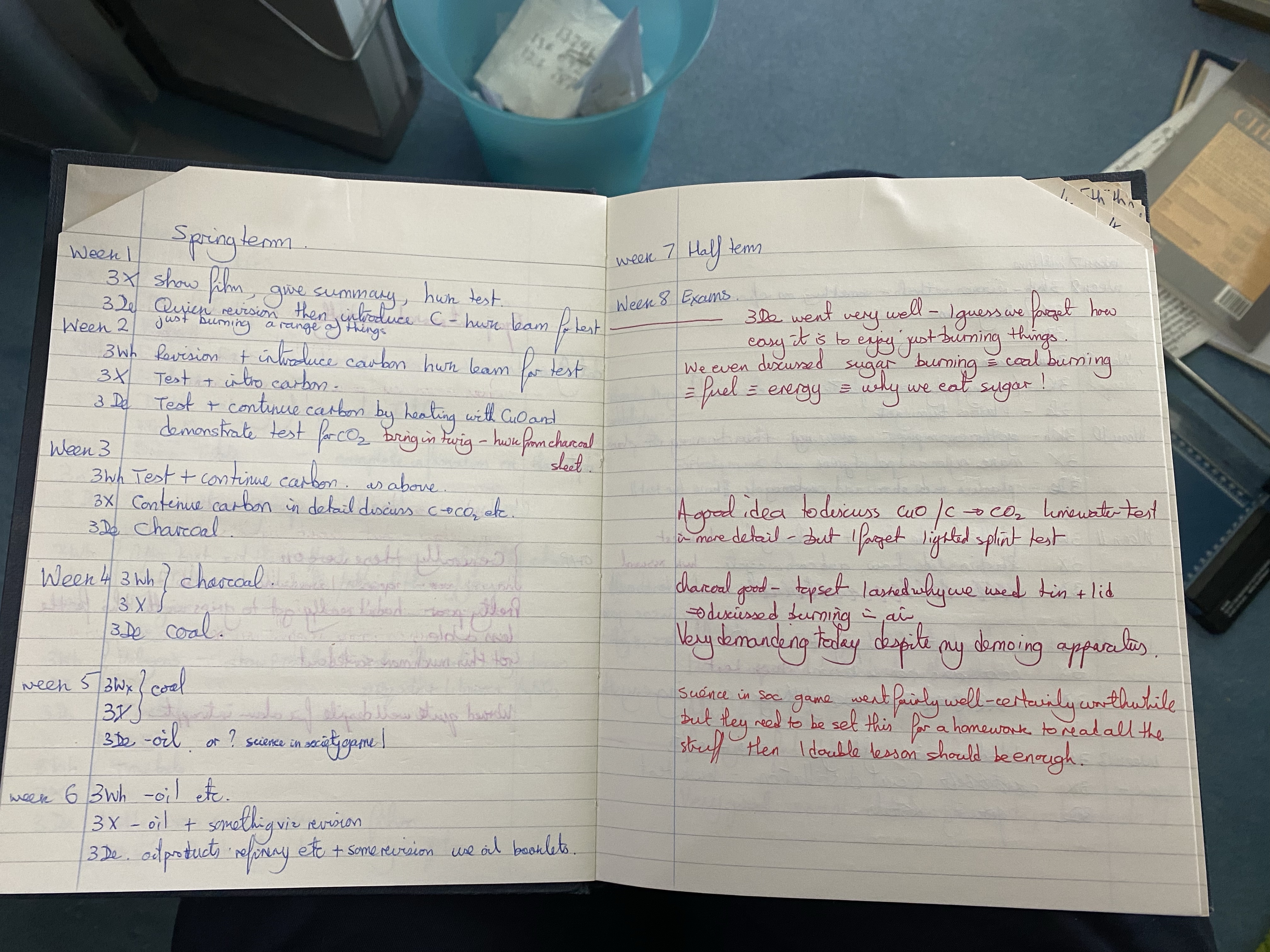
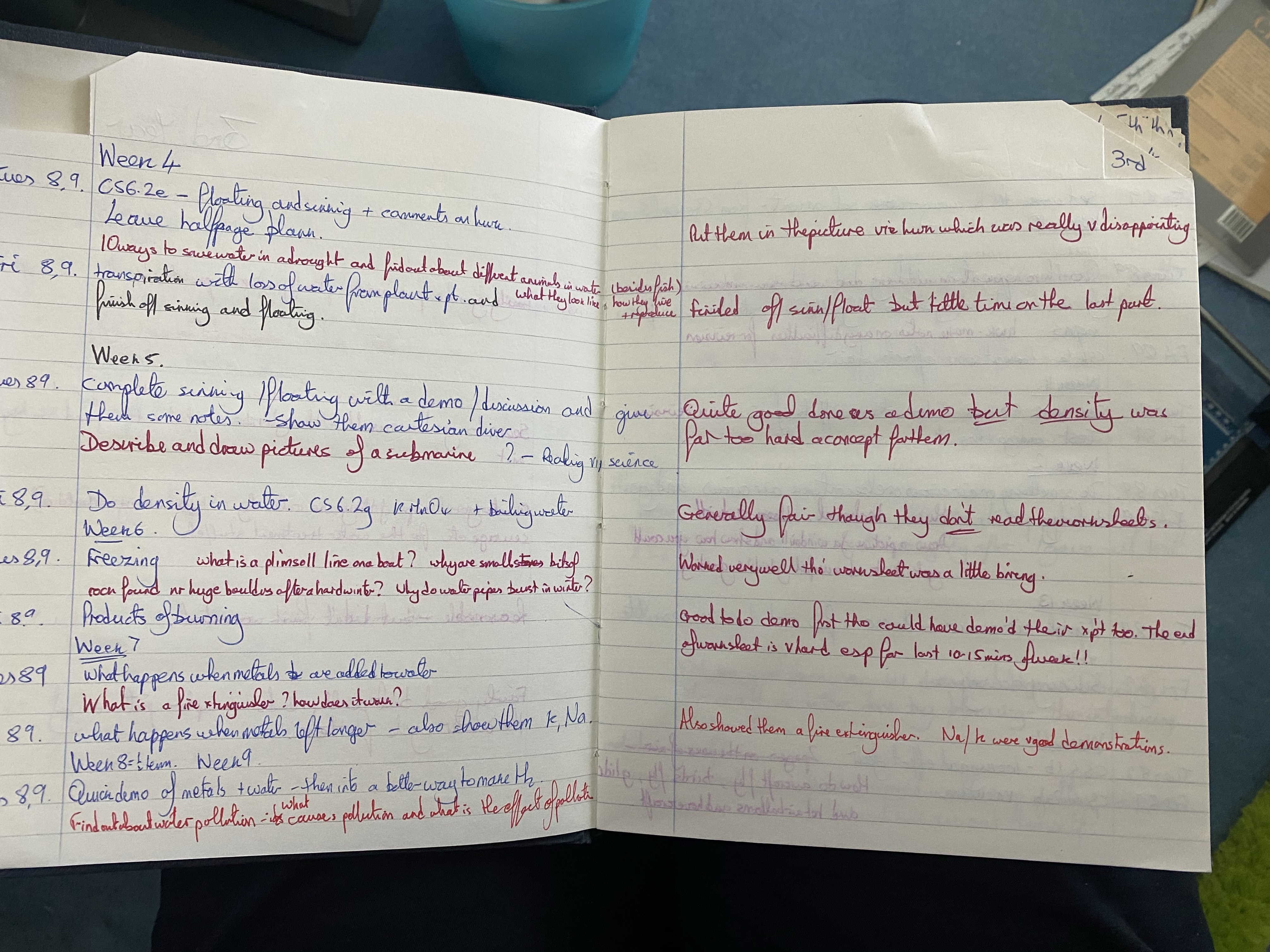
In my early years there were no MATS, not even many INSET days ( preBaker). Toward the end of my first year I had missed opportunity to analyse and think about what I was doing – not a surprise , my PGCE saw about 50% timetable and I was now over 75%. My reflections were brief as the phots show.

I had a very difficult third year class, Y9 – we would have called them low ability. Whatever I did, interesting practicals or care with language, shout or stay very calm, it did not win them over. Discipline was OK actually but they just didn’t seem to learn. Tests often showed deterioration not progress. So one day I asked them who was the favourite teacher and who helped them learn best. Imagine my suppose when with one voice they gave the name of the elderly colleague, an English teacher. I asked her if I could observe her and she welcomed me with open arms.

The class arrived and entered her beautiful room orderly cheerful and keen, they sat down no trouble, they automatically got books and notes out. I was baffled, I mean this was English, activity was limited. Miss S set off by telling them it was spelling test day. Not a murmur, just found their spelling jotters. To honour me they had scientific terms….. out came the likes of aluminium, separate, science etc. they swopped papers, and Miss went through the correct spellings. BUT she didn’t take down the marks. I thought nothing of it. the lesson moved on to study some poetry – even I found it a challenge but they listened, they concentrated, often half the class had hands up at every question. they worked in silence, they asked some clever questions. Towards the end she said it was spelling rerun time and she reran the spelling test, everyone did better (of course). She took the marks down for that test. The bell went, they slowly packed away, no rush to leave, no wild comments, many a ‘thank you’.

As I sat there, a light went on, Miss S had shown them in black and white terms that this class which found learning so challenging, well she had proved they could learn. From initial spelling scores of 2 or 3 correct they finished with 8 or 9 and that made them feel good, made them want more, made them adore Miss S and enabled her to teach them really well because they knew they could really learn.

Teachers finds clever creative, innovative ways to motivate pupils and classes but the best and the lesson I learnt that day is we always have to show, however hard the content is (and listen Chemistry has plenty) with thought and planning, with magic and mystery it is possible to convince pupils they really can learn. This is the hidden challenge and hidden joy of the craft of a classroom. I was indebted to this wise (old) colleague forever.

China > curiosity, culture and challenge

China – a visit thanks to Access China UK and the Nottingham Confucius Institute and Nottingham City Council

An amazing experience, which would have been incredible and fantastic but was made even moreso or as we teacher’s say “EBI” ( even better if) for the fact I went with 9 great Nottingham City colleagues and we had a wonderful Chinese guide and interpreter,  all of whom added the value to make it totally amazing.

img_9008

Feifei our interpreter at the Ningbo library

IMG_2801

The Ningbo 10 (ignore the man on the right he wasn’t with us!)


\


You cannot go up the Pearl of Shanghai and look over the biggest City in the world (population 24 million) and not think – this is where the future of the world will be centred and so we need a plan, not a Brexit neither an educational plan but a proper plan.

IMG_3171

img_9151


China is a long way away – 5750 miles to be precise or exactly 24 hours from me leaving a hotel in Shanghai to arriving at my front door in Nottingham. But it’s also a long distance away culturally and we so enjoyed discovering just touching upon something of its culture.

It’s a country of the highest population 1.4 billion –roughly 24 times the population of the UK and yet the 4th biggest by area which means a lot and I mean a lot of tower block apartments offices and hotels. Shanghai is the biggest City in the world. (24.2 million). We travelled to Ningbo about 4 hours away, including crossing a bridge of 16km to Ningbo, a City the size of London. It’s busy on the roads but those on cycles, motorcycles or even walking seem to just move at random and hey the cars stop and we saw no accidents. Green spaces are precious.

IMG_9106

Red amber green >GO GO GO

img_3185

Bicycle check, mobile check, helmet -what? Few cares in the world, hoping everyone else will stop.

We enjoyed wonderful cuisine – not like westernised Chinese food. We ate like royalty with exquisite food brought out for us, vegetable dishes, meat, noodles, all kinds of tastes, flavours and textures but not too much rice, rice comes at the end and you are not really expected to eat it. Oh and we used chopsticks all the time. Meals were very sociable, no distractions and plenty of conversations, and no rush, no TV, little wifi. That’s less cultural and more….common sense.


We were very well looked after by our guides, interpreters and hosts, who took us to the most interesting of places from tourist spots, to restaurants and of course to ensuring we travelled to time. In China one is never late. They could not have been more helpful, supportive, informative and generous, as were the hotels we stayed in and all the colleagues we met. And there was a thing – I asked one teacher what she hoped for her pupils “to give them every opportunity to learn”. QED the commonality of the vocation.

The culture is well documented but we were shown honour, respect, admiration and treated with huge kindness and generosity by our hosts. I was delighted to be part of a team that did exactly the same for one another on the trip especially when ‘stuff’ happened and they looked out to encourage, share and support even though we hardly knew each other beforehand. Representing different sectors the conversations gave us all further insight and arguably the best of CPD (one early years, two Primary heads one Primary adviser, four middle leaders from Secondary, one partnership lead and me from the LA). Such enthusiasm to ensure “this works” for our children.


To be a tourist and see the bund and river at Shanghai as well as to go up to the 263m Pearl of Shanghai were something but also wandering the tourist shops and trying to bargain was fun. A privilege to visit the oldest library in China (Ningbo) founded in 1561 and be welcomed as honoured guests was special. More special for us educators as we value our school library or local library and we value lifelong learning. Nevertheless our visit enabled us to consider just how ignorant we were of Chinese history and culture and the potential in the Far East.


What did we miss ? – very little, we had tea, it tasted different but we were ‘tasting’ China. We did not have access to facebook, twitter or google and we had withdrawal but we chatted and we asked questions and discussed education and other matters and we enjoyed the company, well until we hit wifi in a hotel then we caught up on messages via a message/chat system called wechat. We missed traffic jams, we missed litter, we did actually miss a few hours of sleep somewhere along the way. You know something else? We didn’t miss pupils, even English pupils, at that even Nottingham City pupils because we stopped at a service station in this vast country and met 10 pupils from one of our local primary schools – having an incredible time – though perhaps a little tired ( much like us) they were full of the experience.

And so to education and some things I have learned and of course I may be wrong that the whole system looks like this but here are my ponderings :

• Families really value education. Politicians value education. Children value their education. Teachers are highly respected (highest in the world according to this survey). This is a deeply cultural matter and about ethos, respect for schools, for teachers and for learning. We met teachers (sure a small sample but the message overwhelms) full of enthusiasm and diligence, we saw little disruption, and amongst pupils a willingness to work hard and and try your best. There is the extreme high pressures involved in the Gaokao exam but setting that to one side the atmosphere in schools was overwhelmingly positive

Proper resource follows the commitment – beautiful buildings; pride in showing us round. I saw huge sportshall ( possibly 4 full size basketball courts and on the floor above about 30 ping pong tables ( I even played the Principal). Their lecture theatre seated 500. We did not hear any complaint about lack of funding – of course that may be for other reasons, However the conversations reflected on their pride in schools and I was glad to be with a group of Nottingham heads and teachers also proud of their schools. Pay not be better ( not sure really about buying power etc) but most of us would trade a bit for having a culture and pride and a community which hugely respect teachers given consideration and of course good behaviours. [Although my own view is that a vast majority of parents do respect us in the UK – just some politicians and the press don’t always and look where they sit in terms of trust and respect.]


• Teachers teach large groups of 40, and whilst they had nice staff areas to work in, with space to share and discuss, to plan they too felt pressures. It maybe around (only) 3 hours a day at the front but they have no technicians or TAs or other adults in classes. Oh and those evenings when pupils are back in school for several hours studying and doing homework, guess who supervises. Heads and teachers take pride in pupils and in their learning. We heard about two schools at the Bureau sharing speeches and we shared about our two, and common features – pride in the opportunities we offer, in the children’s achievements and the aims and ethos in every school and that included to help our children be global citizens. I asked how the head got his children to work hard – “I don’t have to do anything” he said. Just think what all that means for attendance, punctuality behaviour, background disruption, offering opportunities…..


• I loved the creativity I saw, in particular pride in traditions, but also in creating new traditions. IMG_2883We saw some amazing artwork, incredible calligraphy, beautiful ceramics, others saw sport and music to an amazing standard. We met artists in residence and I was invited to play a computer at a board game, a computer that literally picked up pieces in response to my move and you guessed it – the programme and the hardware created by ….a pupil from scratch.

IMG_2991

a CRT – a what?


I also had a discussion with a Chemistry teacher – he had created something but our interpreter didn’t know the words, we had a small hand held device that translated and he said it was a ‘CRT’ and I said ‘oh a Cathode Ray Tube’ and we whooped! I mentioned Thomson, electrons, Crookes and we needed no interpreter –  science can be such a powerful language in itself but check out these facilities:

img_2996


• Willingness to stay and learn and take every opportunity including boarding, yes boarding for the weekdays because half an hour journey home was “too far”. Long days without TV, without Facebook, without mobile devices and perhaps without immediate family because, they all believe in the benefits from social activity and learning. So we saw some pupils who did more hours of homework in a two days than some of our pupils would do in school in a day. Of course there are concerns about resilience and pressure too.

Hospitality and generosity – we took gifts with us for our school and Bureau colleagues and received many back but sometimes individual  pupils wanted to give us something they had done, some  clearly stayed up to make gifts for their visitors.

IMG_3357

MrMcNeill with a beautiful painting made especially for him

I was privileged to pass as one of my gifts the music of Sheku Kanneh Mason ( an ex pupil at my old school) who also kindly wrote me a personal message for the schools which I had translated – that went down really well. ( thank you Sheku). But oh, we had fun – trying out our mandarin, working out currency, bartering, wondering where we were heading when taken by taxi to a school, getting trapped in hotel door (me trying to metaphorically to “open doors”) – looking out for each other and smiling our way through.


• Education bureau officials welcomed our vision for future work with them, they are interested in what we are doing and especially how we measure impact. How we know our City wide plans and also our school plans are being effective, as well as our regulator (ofsted) view. They are keen to foster further links Ningbo > Nottingham and Nottingham > Ningbo. we have lots of ideas from championing exchanges and learning mandarin through to just a better basic understanding of China and our own Chinese community. To be honest they struggled to understand how our system works if it means a local area does not have any control of schools. Welcome to my world!

It is quite an amazement that across the world they are interesting in learning from us.


IMG_3356My colleagues are now busy working out how to manage exchanges, to plan visits with children and to welcome children here to Nottingham. We are looking at how we can work together across the distances and cultures but with an internet and with colleagues here and our own traditions – Nottingham has a University campus in Ningbo which we visited and so there is much to consider and challenge and much remains to be curious about. For me I am committing to try and open more doors with friends in Ningbo – and not these doors.

A slight rant over ‘Textbooks’ which I love*

“…a book that contains detailed information about a subject for people who are studying that subject”

1 I once wrote a Chemistry textbook – with two other great Chemistry teachers –

IMG_1176

Our Foundation level textbook

not examiners, not academics just plain Chemistry teachers. It was for the so-called less able or foundation GCSE pupils, labels I use but intensely dislike and I learned a lot win writing it and it was a fantastic challenge to help lots of pupils access our subject – especially those who find it hard – which is nearly everyone. It didn’t make us a fortune, schools bought lots of texts for the more able ( have a copy at home have a copy in school etc, but this was for the less able who were in small groups and often weren’t allowed to take a book home). Continue reading

Why be an Education Director?

A question in the mindset of Mrs Merton.

What first attracted you to the role of Education Director (part time) in Nottingham, after all the City now “runs” very few schools?

school-children2

Not so long ago this role would have been one of the biggest in education in Nottingham running secondary, primary and special schools, responsible for everything from admissions to outcomes and most stuff in between for about 41,000 children. As the ‘new world’ of academisation has emerged resources have passed from the local authority to the new trusts except for some statutory services. As the landscape no longer looks the same, the role of a City Education Director needs to change and I’m not sure anyone in any LA has worked out how, but we are well on the journey in Nottingham. Much of that is thanks to the pioneering work of Pat and Sarah Fielding and their excellent work in many areas pre-eminently with our City Primaries and with safeguarding. So how does it appear picking up the reigns?


For me, there is still a rather wonderful, overwhelming desire by everyone I meet in the City linked with education, they want to improve the lives of young people. Whether I speak to people at the City LA : SEND colleagues, those working out how best to help refugee and asylum seekers with EAL issues, those working with the very special, children in care, they have massive professional and personal commitment to their roles. When I have spoken to headteachers, teachers and CEO’s of Trusts or governors, they always begin by talking about children, young people, families they are working with and only rarely and then usually a moan about systems and structures. Hang it I even found the same in my meetings with Ofsted inspectors, with the RSC and other ‘officials’ – what can we do to improve things – though of course some of the latter are stuck with their systems. There are actually good starting points from organisations like EEF, who are also keen to help Nottingham. I think we are also fortunate with our local and national politicians who are supportive, understanding and yet not afraid to challenge us all.

imageAs a chemistry teacher who has loved the job in the classroom, and on corridors, who was challenged and supported in school leadership roles I loved working with young people and…still do. At the heart for all of us is working with children to help them learn from all their opportunities and that is my hope, to bring something of that perspective to the role. Working in partnership and in collaboration.

pareto_principle_improveA key energy for us in the City is so-called school improvement, frankly I don’t really like the title and as a headteacher refused to have a SIP (school improvement plan). I wanted a “school development plan”. Schools are full of people trying to do their very best, and we can’t keep asking for more and more. Schools might be able to genuinely improve some parts of their work and service but they face almost constant and considerable change. As a teacher I might work to understand how assessment works for my GCSE students, how best to help them learn science, to achieve and how to motivate them and excite them – but then…aha, the content changes (probably not too much) and the assessment changes (probably a lot) and the way me and my school are made accountable for their progress changes. imageThen my next class have different needs, a child coping with bereavement, one struggling with domestic violence, one with mental health pressures, one just lost in the world and a fair few just confused by my explanations. In classrooms, in staffrooms and in head’s offices alongside governor meetings there are always discussions happening to see how to help the children learn. As well as staff having to manage the wider changes in technology, in policy, in society and in the world around us. For me improvement and progress are part of the school day, routines, habits not goals.  It’s not about forever improvement it’s about having the best job in the world and feeling you are doing a great job for young people because that’s why you came into the role, and we need to support each other and make it a sustainable rewarding job.

Robin-Hood-Statue

So knowing classrooms reasonably well, understanding a good bit about leadership from long experience and something of the local educational world from most of my working life spent in Nottingham, you know what? I think I might be able to help make a difference working alongside you.


Sometimes it does feel impossible, even just in secondary our 17 schools are in 9 very different multi academy trusts, complex communities. We have great Universities, we have a revitalised FE sector wanting to help but they are big organisations. We have agencies like Futures and a voluntary sector, often with great ideas but struggling to get engagement as they see it. It feels impossible when data shows a disappointment, maybe a dip in achievement or progress or a bump in attendance. However, whoever I have spoken to, they are willing to roll their sleeves up look at the problem and try to find a solution. ( heck, we chemists are good at that too) …and the starting point – what can we do to improve this situation and improve things for those children. So I hope to bring partners together and improve the landscape, to eventually proved some agreed strategic direction, and to work with the Education Improvement Board to do just that….Improve Education.


imageNottingham is the 4th poorest City in England, we have some long-standing historical deprivations and some major lack of aspiration but you know what, we have a workforce and a commitment from the professions second to none, and a personal effort from so many showing time and time again a willingness to go the extra mile. We have some great young people, and large numbers who buck trends. At Trinity, I often spoke to the staff, children and parents about hope – ‘there is always hope’. It’s my hope to help make partnership work, have high levels of collaboration, to share good ideas that genuinely work, and to try and find solutions to complex problems in order to bring hope to the children in Nottingham and pride to their families, friends, teachers and themselves.

 

Here’s hoping you will be able to find some  time and energy to commit to working with us on the project!

web-Balloon-girl


Tuesday period 7 -The importance of being earnest about Subject Knowledge.

This week I had the privilege of speaking to the PGCE mentors at Nottingham University about subject knowledge. We were trying to think about the importance of subject knowledge when training teachers compared to all the other pedagogical an

d classroom management that goes on in helping shiny new teacher trainees as they learn the craft of the classroom. The stuff that inevitably has to go on – behaviour management, question technique etc made me think about the importance of subject knowledge in learning to be a teacherimage. You need a big erudite quote talking to a load of PGCE mentors at a prestigious University so I went for a Cloughie quote. “Players lose you games not tactics. There is so much crap talked about tactics by people who barely know how to win at Dominoes.” This made me think because Clough’s point really is that there are all sorts of people with opinions and views telling him how to run his team but actually it is players that win games. As a head teacher I am acutely aware we get all sorts of advice, guidance and “this is how to” BUT  it is teachers that make a difference.

  • teachers not systems
  • teachers not policies
  • enthusiastic, inspiring and knowledgeable teachers.

Policies and systems are important but no one decides to become a teacher because of policies and systems, they decide to become a teacher because they were inspired by a teacher or by a subject or both; they love children and now they have a subject they wish to share. My audience were present as PGCE mentors because of a deep desire to help the next generation of teachers, to create more teachers and we head teachers like to find inspiring knowledgeable shiny new teachers.

Some Subject Knowledge Myths

Graduates know everything about their subject when they graduate as though the things they didn’t quite understand when they went into finals having got their 2:1 or even 1st somehow mysteriously drop into the brain. The 30% you got away without knowing is now “in the brain” Well it sure isn’t! After graduation I did one year of reseach and in my first day of lab work used  a chemical (Benzoyl Chloride for those interested] which was described as a powerful lachrymator, but me and my arrogance not wanting to check  at what lachrymator meant just assumed it was the word that meant you went to the toilet a lot. so I took care not to drink or taste it [not difficult] having completed my experiment threw my solution down a sink to find a whole lab of chemists with tears streaming down their faces having to leave the room and as we were evacuated me being totally embarrassed. No the gaps of knowledge are not filled in!

Graduates knowledge automatically updates as the world discovers more about that subject new gaps occur. Or maybe some part of history you have to teach wasn’t covered in HE. Or suddenly as an English teacher you have to understand the new 19th century novel thanks to Mr Gove designing the spec. This can be seen as nuisance or you can have the attitude of my brilliant English staff and see it as a chance to read stuff you haven’t read before.

IMG_2928The school curriculum, the school content never changes hey have in my subject I can tell you a topic like Solubility has come and gone and came back it. The Born Haber cycle was in then out then back in a new form then gone and I’ve not checked the new specs!


Some Subject Knowledge Truths

Graduates know more about their subject than school students. We hope that’s true after 3 years and £27,000 and all of us should be able to keep ahead on knowledge

Graduates worry about other aspects of the classroom. Shine new ITT people have other bothers:

  • Will the pupils behave
  • Will I cope with the marking, feedback, will I even be able to answer the exam question myself
  • Will their parents moan about me
  • Will my classroom turn into an example of chaos and riot
  • Agh should I be a teacher

It’s nimageot just about knowledge. Back in the day when I did a PGCE we had what we called books and if you were asked a question the answer was in a book so you found it there or bluffed. Now you can google it, so can pupils, but learning is much deeper matter and, it’s really all about

  • Understanding,
  • reasoning,
  • application,
  • synthesis …..maybe more

Knowledge has to fit into a curriculum. Whatever knowledge the graduate has or does not have the demand is in a curriculum be that for Y7 for Y9 top sets or for GCSE or Level and maybe when we get this wrong we underestimate our pupils and maybe there is truth in the Ousted chiefs criticisms of the way we work with bright pupils

Graduates should be able to make a subject “come to life”. OK there is a curriculum but get the  best bits of your subject, the exciting and interesting stuff into the lesson. Children love this and if we keep winning them over they will enjoy the lesson, learn and see they can progress. That is the virtuous circle of success

Stay in the mainstream of being a subject specialist. I am a reasonable Chemist ( hey Ive a degree and an FRSC) Im an OK Chemistry teacher- but when you give me KS3 biology I can kill it. I never did any Biology, in my day an all boys grammar didn’t do Biology.

image

Sir I don’t think you know how to use this microscope

I did a little in my degree and sure I can teach it BUT do I know if this lesson on photosynthesis is putting the right emphasis on the right foundations. Bet someone who taught KS4 or 5 would identify better the exact basics to grasp. One reason I think our Maths and English results are so good is because people teaching KS5/4 teach Y7 and Y8 – when they cover adverbs in Y7 they sure have an eye on what will be needed post16 or GCSE and make sure they start building it well. Drip feed complex ideas form an early age.


A few challenges

Pupil growth in understanding mirrors yours. There are always better ways to teach better ways to work out how to deliver your subject after a few years of working out that this be the topic doesn’t get a learnt very well in that particular way we is the subject experts can probably sit down and find a better way. in the 80’s I taught Chemistry the same way I had been taught and the same route as my degree. By the time of Salters I was teaching JUST the part needed at a particular stage, we revisited ideas, we did ideas in a circular way that genuinely held learning and it meant we revisited Chemical ideas. It worked and worked well and we  saw that in results in numbers carrying on in the subject and guess what – we saw it in their understanding. Avoid the errors of dropping really difficult concepts and ideas on pupils too early in their learning before they are mature enough to cope.

Importance of the story of the subject (even Maths). All subjects even Maths have a story to tell – a history, a set of characters, set of discoveries, a context, a baddie a discovery. I can name you all these in Chemistry. Have a fund of stores or look at my post on storytelling.

Importance of secuIMG_2943re understanding not teaching to test – PPS (past paper syndrome). No teacher reading this hasn’t had the frustration of a pupil asking “whats in the test?” or doing past papers sometime in January and not doing very well.  We need to use our own deep understanding of our subject to show pupils just how to grasp, understand, learn and progress.
No point doing exam papers (yet) be secure in your knowledge and understanding) and sure we might have to do some simple testing to see if you have and to see how we help.

Using new technologies. I love what I have in the toolbox for teaching so we must keep an eye on ICT or Activites to enhance BUT we use out subject knowledge. I’m reminded of some of the early software I was shown by enthusiastic software salesmen aiming  to show me how wonderful chemistry could appear  on the interactive whiteboard. Watch! You can pull a virtual bottle of acid from here and look you can pull across test tube and choose a bit of zinc or other metal to add. Now, drop it in and click here to open the bottle and look the equation is written underneath and there is the reaction: some bubbles of hydrogen the pupils can guess what it is and the little splint will come over and on imagethe screen appears the word “pop” what do you think of that? It’s quite nice but I’d rather g
et a bottle of acid out give it to my pupils and a test tube and let them do the pop test to see the delight in their faces and the motivation which will probably drive them to work out the equation ready for tomorrow when if they’ve worked it out they can do a few more themselves in real life. Use technology but use your subject common sense

Importance of the keepy uppy in your subject there is the obvious importance of keeping up in the subject and chemistry as in most subjects things has seen dramatic changes. Nanotechnology didn’t exist back in the 80’s. We need to keimageep up with our knowledge, we should enjoy that. It will get us excited: a new material anew discovery, scientist on the international space station. I teach my pupils about DNA and the structure and hydrogen bonding and it’s fascinating and actually give them the 1953 article (a single side of A4 paper) that was in nature and I remind them that in
1953 this won a Nobel Prize and in 2016 it might get them three marks in an exam.Surely there is nothing more important than us keeping up our frontier knowledge to excite and inspire the next generation – cos someone did that for us , a teacher a copy of New scientist a TV programme. Get in touch with your professional subject: ASE or RSC for me.

Delight of discussion of your subjectone of the best parts of the teacher’s job is spending time in the staffroom or on CPD opportunities OR with pupils, talking through some of the issues. How can we make this better? What does this mean? Did you know that? Have you seen this? Hey and if you can draw in other staff, the renaissaince people in te staffroom then the discussion makes the job richer, and all the better

Lifelong learning. You and I dream of creating lifelong learners, and we are lifelong learners of our sunbelt. Use the vehicle of your subject knowledge to sign the deal.


Some Questions

Q1 what importance does your ITT, NQT RQT or frankly your CPD programme place on Subject Knowledge?

Q2 Have we neglected subject knowledge at the expense of pedagogy and lost out

Q3 Should we try and wrestle subject knowledge back to being the “first love”?