China – a visit thanks to Access China UK and the Nottingham Confucius Institute and Nottingham City Council
An amazing experience, which would have been incredible and fantastic but was made even moreso or as we teacher’s say “EBI” ( even better if) for the fact I went with 9 great Nottingham City colleagues and we had a wonderful Chinese guide and interpreter, all of whom added the value to make it totally amazing.

Feifei our interpreter at the Ningbo library
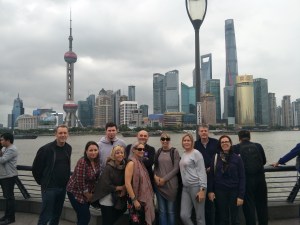
The Ningbo 10 (ignore the man on the right he wasn’t with us!)
\
You cannot go up the Pearl of Shanghai and look over the biggest City in the world (population 24 million) and not think – this is where the future of the world will be centred and so we need a plan, not a Brexit neither an educational plan but a proper plan.


China is a long way away – 5750 miles to be precise or exactly 24 hours from me leaving a hotel in Shanghai to arriving at my front door in Nottingham. But it’s also a long distance away culturally and we so enjoyed discovering just touching upon something of its culture.
It’s a country of the highest population 1.4 billion –roughly 24 times the population of the UK and yet the 4th biggest by area which means a lot and I mean a lot of tower block apartments offices and hotels. Shanghai is the biggest City in the world. (24.2 million). We travelled to Ningbo about 4 hours away, including crossing a bridge of 16km to Ningbo, a City the size of London. It’s busy on the roads but those on cycles, motorcycles or even walking seem to just move at random and hey the cars stop and we saw no accidents. Green spaces are precious.
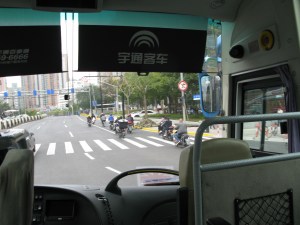
Red amber green >GO GO GO

Bicycle check, mobile check, helmet -what? Few cares in the world, hoping everyone else will stop.
We enjoyed wonderful cuisine – not like westernised Chinese food. We ate like royalty with exquisite food brought out for us, vegetable dishes, meat, noodles, all kinds of tastes, flavours and textures but not too much rice, rice comes at the end and you are not really expected to eat it. Oh and we used chopsticks all the time. Meals were very sociable, no distractions and plenty of conversations, and no rush, no TV, little wifi. That’s less cultural and more….common sense.


We were very well looked after by our guides, interpreters and hosts, who took us to the most interesting of places from tourist spots, to restaurants and of course to ensuring we travelled to time. In China one is never late. They could not have been more helpful, supportive, informative and generous, as were the hotels we stayed in and all the colleagues we met. And there was a thing – I asked one teacher what she hoped for her pupils “to give them every opportunity to learn”. QED the commonality of the vocation.
The culture is well documented but we were shown honour, respect, admiration and treated with huge kindness and generosity by our hosts. I was delighted to be part of a team that did exactly the same for one another on the trip especially when ‘stuff’ happened and they looked out to encourage, share and support even though we hardly knew each other beforehand. Representing different sectors the conversations gave us all further insight and arguably the best of CPD (one early years, two Primary heads one Primary adviser, four middle leaders from Secondary, one partnership lead and me from the LA). Such enthusiasm to ensure “this works” for our children.


To be a tourist and see the bund and river at Shanghai as well as to go up to the 263m Pearl of Shanghai were something but also wandering the tourist shops and trying to bargain was fun. A privilege to visit the oldest library in China (Ningbo) founded in 1561 and be welcomed as honoured guests was special. More special for us educators as we value our school library or local library and we value lifelong learning. Nevertheless our visit enabled us to consider just how ignorant we were of Chinese history and culture and the potential in the Far East.


What did we miss ? – very little, we had tea, it tasted different but we were ‘tasting’ China. We did not have access to facebook, twitter or google and we had withdrawal but we chatted and we asked questions and discussed education and other matters and we enjoyed the company, well until we hit wifi in a hotel then we caught up on messages via a message/chat system called wechat. We missed traffic jams, we missed litter, we did actually miss a few hours of sleep somewhere along the way. You know something else? We didn’t miss pupils, even English pupils, at that even Nottingham City pupils because we stopped at a service station in this vast country and met 10 pupils from one of our local primary schools – having an incredible time – though perhaps a little tired ( much like us) they were full of the experience.
And so to education and some things I have learned and of course I may be wrong that the whole system looks like this but here are my ponderings :
• Families really value education. Politicians value education. Children value their education. Teachers are highly respected (highest in the world according to this survey). This is a deeply cultural matter and about ethos, respect for schools, for teachers and for learning. We met teachers (sure a small sample but the message overwhelms) full of enthusiasm and diligence, we saw little disruption, and amongst pupils a willingness to work hard and and try your best. There is the extreme high pressures involved in the Gaokao exam but setting that to one side the atmosphere in schools was overwhelmingly positive
• Proper resource follows the commitment – beautiful buildings; pride in showing us round. I saw huge sportshall ( possibly 4 full size basketball courts and on the floor above about 30 ping pong tables ( I even played the Principal). Their lecture theatre seated 500. We did not hear any complaint about lack of funding – of course that may be for other reasons, However the conversations reflected on their pride in schools and I was glad to be with a group of Nottingham heads and teachers also proud of their schools. Pay not be better ( not sure really about buying power etc) but most of us would trade a bit for having a culture and pride and a community which hugely respect teachers given consideration and of course good behaviours. [Although my own view is that a vast majority of parents do respect us in the UK – just some politicians and the press don’t always and look where they sit in terms of trust and respect.]


• Teachers teach large groups of 40, and whilst they had nice staff areas to work in, with space to share and discuss, to plan they too felt pressures. It maybe around (only) 3 hours a day at the front but they have no technicians or TAs or other adults in classes. Oh and those evenings when pupils are back in school for several hours studying and doing homework, guess who supervises. Heads and teachers take pride in pupils and in their learning. We heard about two schools at the Bureau sharing speeches and we shared about our two, and common features – pride in the opportunities we offer, in the children’s achievements and the aims and ethos in every school and that included to help our children be global citizens. I asked how the head got his children to work hard – “I don’t have to do anything” he said. Just think what all that means for attendance, punctuality behaviour, background disruption, offering opportunities…..


• I loved the creativity I saw, in particular pride in traditions, but also in creating new traditions.  We saw some amazing artwork, incredible calligraphy, beautiful ceramics, others saw sport and music to an amazing standard. We met artists in residence and I was invited to play a computer at a board game, a computer that literally picked up pieces in response to my move and you guessed it – the programme and the hardware created by ….a pupil from scratch.

a CRT – a what?
I also had a discussion with a Chemistry teacher – he had created something but our interpreter didn’t know the words, we had a small hand held device that translated and he said it was a ‘CRT’ and I said ‘oh a Cathode Ray Tube’ and we whooped! I mentioned Thomson, electrons, Crookes and we needed no interpreter – science can be such a powerful language in itself but check out these facilities:


• Willingness to stay and learn and take every opportunity including boarding, yes boarding for the weekdays because half an hour journey home was “too far”. Long days without TV, without Facebook, without mobile devices and perhaps without immediate family because, they all believe in the benefits from social activity and learning. So we saw some pupils who did more hours of homework in a two days than some of our pupils would do in school in a day. Of course there are concerns about resilience and pressure too.
• Hospitality and generosity – we took gifts with us for our school and Bureau colleagues and received many back but sometimes individual pupils wanted to give us something they had done, some clearly stayed up to make gifts for their visitors.

MrMcNeill with a beautiful painting made especially for him
I was privileged to pass as one of my gifts the music of Sheku Kanneh Mason ( an ex pupil at my old school) who also kindly wrote me a personal message for the schools which I had translated – that went down really well. ( thank you Sheku). But oh, we had fun – trying out our mandarin, working out currency, bartering, wondering where we were heading when taken by taxi to a school, getting trapped in hotel door (me trying to metaphorically to “open doors”) – looking out for each other and smiling our way through.
• Education bureau officials welcomed our vision for future work with them, they are interested in what we are doing and especially how we measure impact. How we know our City wide plans and also our school plans are being effective, as well as our regulator (ofsted) view. They are keen to foster further links Ningbo > Nottingham and Nottingham > Ningbo. we have lots of ideas from championing exchanges and learning mandarin through to just a better basic understanding of China and our own Chinese community. To be honest they struggled to understand how our system works if it means a local area does not have any control of schools. Welcome to my world!
It is quite an amazement that across the world they are interesting in learning from us.


 My colleagues are now busy working out how to manage exchanges, to plan visits with children and to welcome children here to Nottingham. We are looking at how we can work together across the distances and cultures but with an internet and with colleagues here and our own traditions – Nottingham has a University campus in Ningbo which we visited and so there is much to consider and challenge and much remains to be curious about. For me I am committing to try and open more doors with friends in Ningbo – and not these doors.


 I always found the first full ‘normal’ week back quite hard, I’m not sure what the next class would bring into the room, I got a bit sick of the sound of my voice, the holiday had no bells and now they ring the lesson start and end. Nevertheless it is the start, it’s the beginning of an exciting new journey. Welcome back to the new term and being in the challenges and opportunities of teaching and learning.

 As a chemistry teacher who has loved the job in the classroom, and on corridors, who was challenged and supported in school leadership roles I loved working with young people and…still do. At the heart for all of us is working with children to help them learn from all their opportunities and that is my hope, to bring something of that perspective to the role. Working in partnership and in collaboration.
 A key energy for us in the City is so-called school improvement, frankly I don’t really like the title and as a headteacher refused to have a SIP (school improvement plan). I wanted a “school development plan”. Schools are full of people trying to do their very best, and we can’t keep asking for more and more. Schools might be able to genuinely improve some parts of their work and service but they face almost constant and considerable change. As a teacher I might work to understand how assessment works for my GCSE students, how best to help them learn science, to achieve and how to motivate them and excite them – but then…aha, the content changes (probably not too much) and the assessment changes (probably a lot) and the way me and my school are made accountable for their progress changes.
  Then my next class have different needs, a child coping with bereavement, one struggling with domestic violence, one with mental health pressures, one just lost in the world and a fair few just confused by my explanations. In classrooms, in staffrooms and in head’s offices alongside governor meetings there are always discussions happening to see how to help the children learn. As well as staff having to manage the wider changes in technology, in policy, in society and in the world around us. For me improvement and progress are part of the school day, routines, habits not goals. It’s not about forever improvement it’s about having the best job in the world and feeling you are doing a great job for young people because that’s why you came into the role, and we need to support each other and make it a sustainable rewarding job.
 Nottingham is the 4th poorest City in England, we have some long-standing historical deprivations and some major lack of aspiration but you know what, we have a workforce and a commitment from the professions second to none, and a personal effort from so many showing time and time again a willingness to go the extra mile. We have some great young people, and large numbers who buck trends. At Trinity, I often spoke to the staff, children and parents about hope – ‘there is always hope’. It’s my hope to help make partnership work, have high levels of collaboration, to share good ideas that genuinely work, and to try and find solutions to complex problems in order to bring hope to the children in Nottingham and pride to their families, friends, teachers and themselves.
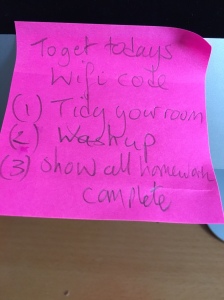
 We began by asking our pupils a series of questions – we did make an important assumption that our community of parents, pupils and teachers see a value in homework so this wasn’t about forgetting or abandoning homework. It was more to pinpoint any stressful areas for each group and see what improvements we might make.
 The following action points came from the pupils:
 The following action points came from parents.


 Why would you want to do a PGCE? It is often a question that gets put to me by many of my family and friends, as well as people I’ve just met, on an almost daily basis. Many people see the headlines in the newspapers and the media portrayal of the teaching career is one which may scare many potential student teachers out of teacher training. So why should people consider it?
 As touched upon earlier, other student teachers will play an important role in your year! The friendships and professional relationships you develop with each other is another exciting element to the course, and by supporting and helping each other, the time spent on the PGCE course will go by even faster, on a course in which the weeks already fly by! Another advantage of developing lasting friendships on the course is the sharing of good resources between each other. This will not only help build up a ‘bank of resources’ which you will find useful for your NQT year, but also help to reduce the time spent on creating resources, helping to create a better working-life balance.
 . You need a big erudite quote talking to a load of PGCE mentors at a prestigious University so I went for a Cloughie quote.
  The school curriculum, the school content never changes hey have in my subject I can tell you a topic like Solubility has come and gone and came back it. The Born Haber cycle was in then out then back in a new form then gone and I’ve not checked the new specs!
 ot just about knowledge. Back in the day when I did a PGCE we had what we called books and if you were asked a question the answer was in a book so you found it there or bluffed. Now you can google it, so can pupils, but learning is much deeper matter and, it’s really all about
 re understanding not teaching to test – PPS (past paper syndrome). No teacher reading this hasn’t had the frustration of a pupil asking “whats in the test?” or doing past papers sometime in January and not doing very well. We need to use our own deep understanding of our subject to show pupils just how to grasp, understand, learn and progress.
 the screen appears the word “pop” what do you think of that? It’s quite nice but I’d rather g
 ep up with our knowledge, we should enjoy that. It will get us excited: a new material anew discovery, scientist on the international space station. I teach my pupils about DNA and the structure and hydrogen bonding and it’s fascinating and actually give them the 1953 article (a single side of A4 paper) that was in nature and I remind them that in
 Mr John Dexter blogs about school